Multichannel Contact Center: Benefits & Best Practices
- November 29, 2025
- 11 Mins Read
- Listen

Today’s customers can arrive from any channel – sometimes they call, sometimes they text, sometimes they tweet, and sometimes they fill out a website chat form. Regardless of where they connect, their expectation remains crystal clear: Fast, consistent, and convenient support, every single time. This shift is the reason why businesses across industries are moving toward multichannel contact centers. These platforms allow businesses to handle voice, email, chat, SMS, WhatsApp, and social media from one place.
In this guide, we break down what a multichannel contact center is, why it matters, how it works, and how your business can implement it successfully.
What is a Multichannel Contact Center?
A multichannel contact center is a platform that allows businesses to support customers across multiple communication channels, typically, voice calls, email, SMS, live chat, social media, WhatsApp, and mobile apps. The core idea behind the concept of a multichannel contact center is to let customers reach a business through the channel they prefer, without forcing them into a single communication option.
Example of a Multichannel Contact Center
A customer wants to return a product.
-
Email: They send an email asking for the return process.
-
WhatsApp: Later, they share the order photo on WhatsApp.
-
Phone Call: When they need a quick answer, they call the support number.
-
Social Media: They also drop a comment on Instagram asking for an update.
A multichannel contact center lets the business handle all these interactions—email, WhatsApp, phone, social media, but every channel is managed independently.
Omnichannel Contact Center vs Multichannel Contact Center
An Omnichannel contact center also operates using multiple communication channels; however, it connects every channel into one continuous customer journey, with a single shared conversation history. This means that customers can switch channels anytime and still receive seamless, personalized, faster assistance without making them repeat themselves.
|
Feature |
Multichannel Contact Center |
Omnichannel Contact Center |
|
Primary Focus |
Maximum reach across many channels. |
Customer experience (CX) and consistency across all channels. |
|
Channel Integration |
Channels are separate and operate in silos. |
Channels are fully integrated and unified into a single view. |
|
Customer Journey |
Disjointed; the customer must repeat information when switching channels. |
Seamless and continuous, the conversation and context flow from one channel to the next. |
|
Agent View |
Channel-specific view; agents typically only see the history for the channel they are using. |
Unified 360-degree view of the entire customer history across all channels. |
|
Data & Context |
Siloed data; context is often lost when a customer switches channels. |
Shared, synchronized data; full context is maintained across all touchpoints (CRM-integrated). |
|
Customer Effort |
High effort; customers may feel frustrated and have to repeat themselves. |
Low effort; experiences are frictionless and personalized. |
|
Technology |
Separate technology infrastructure for each channel (or basic integration). |
Unified, cloud-based platform with advanced routing and integrated systems. |
|
Goal |
To allow the customer to choose a channel. |
To allow the customer to start a journey on one channel and finish it on another seamlessly. |
Channels Supported in a Multichannel Contact Center
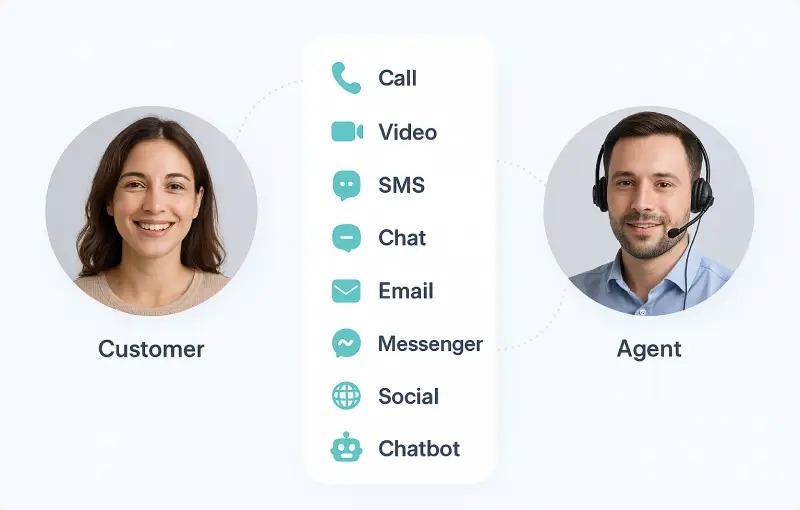
A modern multichannel contact center equips businesses to engage customers across multiple platforms, each serving a different purpose, audience type, and interaction style. While these channels operate independently, together they offer customers the freedom to choose how they want to communicate.
Below are the key channels typically supported:
- Voice Calls
Voice remains the backbone of customer support. In scenarios where complex issues arise, escalations happen, high-value queries arrive, and emotional conversations occur, voice calls remain the most trusted communication channel.
- Live Chat
For quick questions, product assistance, troubleshooting, or helping customers during purchase decisions, live chat is an ideal communication channel. Assisting customers with real-time support it significantly boosts the website conversion rates.
For detailed queries, long conversations, attachments, written records, and situations where customers need time to articulate their issues, email is considered the most suitable channel. Due to its traceability, most ticketing workflows rely heavily on email.
- SMS Support
From alerts, OTPs, service updates, reminders, delivery notifications, and appointment confirmations, SMS is trusted for its speed and simplicity.
- WhatsApp & Other Messaging Apps
Messaging apps help businesses make customer support more natural, conversational, and convenient.
- Social Media Support
Customers increasingly raise concerns on various social media platforms such as Facebook, Instagram, X (Twitter), LinkedIn, and others. This helps businesses respond to public complaints, manage brand reputation, provide quick help to social audiences, and reduce escalations through visible, proactive engagement
- Mobile App Support
In-app chat is becoming essential for brands with their own mobile applications. It enables seamless, real-time support without forcing the user to switch channels. Customers can register complaints, ask questions, or track progress, all within the app.
Features of Multichannel Contact Center Platform

A multichannel contact center brings all your communication channels together, voice, chat, email, SMS, WhatsApp, and more, so customers can reach you however they prefer. To make this experience smooth and efficient, the platform must include the right set of features. Below are the key features that help businesses deliver faster support, improve agent productivity, and create a seamless customer experience across every channel.
1. Smart IVR, Voice Bot & Chatbot
Intelligent IVR flows, AI-powered voice bots, and chatbots automate routine queries, reduce agent load, and deliver instant responses 24/7.
2. Toll-Free, Vanity & DID Numbers
Provide easy access with toll-free lines, enhance brand recall with vanity numbers, and support distributed teams with dedicated DID numbers for departments or agents.
3. AI Chatbot & AI Voice Bot
Advanced conversational AI interacts naturally with customers, handles FAQs, assists with transactions, and improves engagement across every channel.
4. Interactive Communication Tools
Enhance customer support with interactive features like video calls, co-browsing, and screen sharing, ideal for resolving complex issues faster.
5. Ticket Management System
Integrated ticketing keeps all customer issues organized, assigns priority levels, tracks status, and ensures timely resolution across channels.
6. Mobility & Multi-Device Support
Agents can handle calls and conversations from browsers, mobile apps, IP phones, or PSTN lines, delivering flexibility and remote working capability.
7. Easy User & Routing Management
A centralized dashboard enables administrators to manage users, set routing rules, configure IVR flows, and control all communication operations with ease.
8. Crystal-Clear HD Voice Quality
High-definition voice ensures professional communication, reducing misunderstandings and improving customer experience.
9. Call Screening
Gives agents and businesses visibility into who is calling, enabling better preparation and prioritization before answering.
10. Video Conferencing, Chat & File Sharing
Built-in collaboration tools allow teams and customers to connect through video, exchange files, and communicate in real time.
11. Full-Phase AI Support
From routing to analysis, AI enhances every phase of communication through predictive responses, intelligent suggestions, and automated workflows.
Benefits of Multichannel Communications for Businesses

Multichannel contact centers give businesses the ability to provide customers the freedom to choose their preferred mode of interaction. Such flexibility creates a more seamless, efficient, and customer-centric experience. Let’s discuss the key benefits in detail:
1. Higher Customer Satisfaction
Customers today expect freedom of choice; they don’t like being bound to a single communication channel. A multichannel setup allows them to engage through the platform they find most convenient, whether it’s voice, chat, email, social media, or messaging apps.
This “customer-first accessibility” offered by multichannel contact centers reduces friction, increases comfort, and leads to significantly higher satisfaction and loyalty.
2. Faster Response Times
In a multichannel contact center setup, customer requests or queries are distributed across multiple channels, which means no single support line becomes overloaded.
This reduces waiting times, speeds up first responses, and ensures urgent issues are addressed quickly. Clearly, businesses that adopt multichannel support achieve faster resolution rates and impressively lower customer frustration.
3. Increased Agent Productivity
With a unified multichannel interface, agents can manage conversations from different channels in one dashboard, without switching apps or repeating work. This boosts efficiency, reduces tool fatigue, shortens handling times, and allows agents to deliver more personalized support with less effort.
4. Better Customer Insights
Each channel generates valuable data, preferences, behavioral patterns, frequently asked questions, sentiment trends, peak activity times, and more. A multichannel system consolidates all this information to provide a 360° customer view, enabling smarter decision-making, targeted engagement strategies, and predictive customer service.
5. Improved Brand Trust
When customers see a business consistently available across multiple touchpoints, it signals reliability and professionalism. Being present and responsive on the channels customers use the most, like WhatsApp or social platforms, helps brands build trust, authority, and long-term relationships.
6. Scalable CX Operations
A multichannel framework grows as you grow. Whether you need to add more agents, integrate new channels, or expand to new markets, multichannel models adapt quickly without disrupting existing operations. This makes it ideal for fast-scaling enterprises and businesses with evolving customer needs.
Challenges with Multichannel Contact Centers
We have learned the significant strategic benefits of multichannel communication; now let’s explore the other side of the coin as well – the operational complexities of multichannel communication systems.
1. Channel Silos
In a multichannel contact center, all communication channels operate independently, resulting in fragmented customer interactions. This is why proper integration of the channels is necessary to prevent it from becoming a disconnected system.
2. Agent Training Gaps
In a multichannel communication setup, agents might struggle to master operating in multiple communication channels and workflows. For example, a social media support agent might not be trained for structured email responses. This means that continuous training is required to maintain agent productivity and service quality.
3. Higher Volume Management
More number of channels in a communication system increases the volume of customer interactions. This indicates that proper automation, routing, and workforce planning are required to ensure that agents are not overwhelmed.
Best Practices for Setting up a Multichannel Contact Center

With the above challenges, multichannel contact center solutions may sound a bit complex, but hang on, you can set up a system that actually improves customer experience and not just makes things tough by following these practices.
1. Pick the Most Impactful Channels
Rather than launching every communication channel at the outset, choose the ones that drive the highest customer engagement. Some of the most common channels with high customer engagement include voice, live chat, and email.
2. Create Internal Workflows for Every Channel
Consistency prevents miscommunication, which is why each channel in the system should have clearly defined SLAs, escalation rules, tone guidelines, and handling procedures. This helps in ensuring that customers get the same quality of service no matter which channel they choose to communicate.
3. Use Automation Wherever Possible
Automation helps in reducing agent workload, accelerating customer responses, and delivering 24/7 availability. Some of the simple yet impactful ways to automate your multichannel contact center include: configure IVR to route calls efficiently, deploy chatbots for FAQs, order tracking, and basic troubleshooting.
4. Invest in Agent Training
Each channel has its own communication style, pace, and expectations. Investing in agent training should cover various aspects, such as the tone used for the channel, tools for each channel, and soft skills like empathy and writing clarity.
Key Takeaway
A strong multichannel platform helps businesses deliver smoother interactions, faster resolutions, and consistent service across every touchpoint. By adopting the right platform, companies can improve customer satisfaction, boost agent productivity, and scale their operations effortlessly. And with solutions like REVE’s AI-powered Contact Center Suite, you get an enterprise-grade ecosystem powered by secure architecture, smart routing, AI capabilities, and 24/7 global support.
Frequently Asked Questions
Can small businesses use a multichannel contact center?
Yes. Small businesses can start with essential channels like voice, chat, and WhatsApp, then add more channels as they grow.
What industries benefit the most from multichannel contact centers?
E-commerce, banking, telecom, healthcare, travel, and logistics gain the maximum value due to high customer interaction volumes.
Are multichannel contact centers secure?
Yes, especially when hosted on cloud platforms with encryption, access control, and compliance-backed security frameworks.
Can agents handle multiple channels at the same time?
Yes. Modern systems provide a unified dashboard so agents can manage calls, chats, and emails without switching tools.
Do I need a large support team to manage multiple channels?
Not necessarily. With automation, bots, and smart routing, even small teams can manage high volumes efficiently.
Can a multichannel platform improve first-contact resolution (FCR)?
Yes. With full context and CRM integration, agents can resolve issues faster on any channel.
Is data from all channels stored securely?
Yes. With encryption, access control, and compliance frameworks, data stays protected across channels.