How Businesses Are Winning with SMS Communication in 2026
- March 10, 2026
- 23 Mins Read
- Listen

Traditional communication channels like email and phone calls hold a strong ground in the business communication landscape. However, there’s another powerful yet often overlooked tool that helps businesses connect with their customers efficiently and effectively. I’m referring to SMS, or Short Message Service, in business communication. This blog explores the deeper aspects of SMS for business communication, highlighting why SMS is critical for businesses, particularly in the telecom industry, how it can be a powerful tool for generating revenue, and what lies ahead.
The Communication Problem Modern Businesses Face
Let’s start with something uncomfortable. Most businesses don’t have a product problem. They have a communication problem. But more often, they’re not able to figure it out.
A business might have the best pricing, the best network coverage, or the best support team, but if their message doesn’t reach customers at the right time, none of that matters, right? And today, modern communication channels are quietly failing businesses in four major ways, which are:
Email Fatigue is Real & Expensive
Think about your own inbox. It is overloaded with promotions, newsletters, OTP emails, billing reminders, and whatnot. The worst part is that most of these emails are unread.
Now imagine your customers doing the same.
According to stats, as of 2025, there are 4 billion daily email users, with projections estimating an increase to 4.6 billion by 2026. That means your carefully crafted message is competing with millions of others, every single day.
And here’s the kicker: Even though email is considered “professional,” average marketing email open rates across industries hover around 42.35%. That means 58% of your audience may never even see your message. Email isn’t dead. But it’s overcrowded.
App Dependency Limits Reach
There’s a huge ongoing trend: Many businesses invest heavily in mobile apps. On paper, that makes sense. Apps allow push notifications, in-app updates, personalized dashboards, and everything seems controlled. But here’s the reality:
- Not every customer downloads the app
- Not every user enables notifications
- Not every phone has enough storage
- Not every region has stable internet
And even when customers do install the app, push notifications can be disabled in seconds. Communication channels that depend on internet connectivity automatically exclude a segment of your audience.
Low Engagement Across Traditional Channels
Let’s talk about engagement. Businesses today are active everywhere: From email to social media, app notifications, and web banners. But activity does not equal attention, right? According to industry research frequently cited by firms like Gartner, customer attention spans are shrinking while digital noise is increasing.
The outcome? Messages get ignored. If customers don’t open, read, or act on your communication, your marketing ROI drops, regardless of how much you invest. And that’s where many businesses miscalculate. They measure reach. They don’t measure attention.
Telecom Customer Churn is a Silent Revenue Killer
Now let’s address the most serious issue: churn.
Telecom is one of the most competitive industries globally. Customers can switch providers faster than ever. Studies from McKinsey & Company show that improving customer communication and experience can significantly reduce churn and increase lifetime value.
But why do customers leave? Often, it’s not because of one catastrophic issue. It’s because of small, repeated frustrations often in the form of missed billing alerts, delayed service notifications, and poor follow-up.
When communication is inconsistent or delayed, trust erodes. Even a small reduction in churn, say 1–2%, can translate into millions in retained revenue for large operators.
What is SMS for Business Communication?
SMS communication has been a part and parcel of our daily lives for a long time. Likewise, it is also used extensively in business setups for marketing, customer service, and internal communication. SMS for business communication refers to the strategic use of text messaging by companies to interact with customers, employees, and partners in a fast, direct, and reliable way.
It comes as a direct, personalized, and timely medium to engage with customers and build relationships. In contrast to other communication mediums such as email, SMS messages offer a near-instantaneous delivery rate and are also typically read within a few minutes of being sent.
How Business SMS is Different from Regular SMS
When individuals send SMS, it’s typically one-to-one and informal. Unlike personal SMS messaging, SMS in business communication is:
- Sent through SMS gateways or telecom infrastructure
- Delivered at scale (thousands to millions of messages)
- Managed through dashboards and APIs
- Tracked for delivery reports and engagement
- Governed by compliance and consent rules
Telecom companies and enterprises use bulk SMS platforms connected to operator networks to ensure reliable delivery, routing, and reporting.
What are the Different Ways to Use Text Messaging in Business Communication?

There are several ways in which SMS can be utilized to boost business communication. Let’s take a look at some of the most common use cases.
Customer Support
The customer support domain requires providing quick responses to customer inquiries and resolving issues promptly. SMS offers a hassle-free channel for customers to conveniently text their issues and receive prompt support from the business.
Marketing and Promotions
SMS can be used to send targeted discounts, offers, contests, and giveaways related information to customers. For example, businesses can create a sense of urgency and exclusivity by offering limited-time discounts, flash sale coupons, and other similar promotions.
Appointment Reminders
Another excellent usage of SMS in business is sending appointment reminders via text messages. By integrating SMS functionality with the existing appointment scheduling software, a business can automatically send SMS reminders to customers at a specified time before their appointment. For example, sending the reminder a day before the appointment.
Moreover, the SMS reminders can be customized to include appointment-related information such as date, time, and reason for visit.
Order Confirmations and Delivery Status Updates
E-commerce businesses can also utilize SMS to keep their customers informed about orders through SMS notifications, such as confirmation of order, shipping, and delivery. When customers receive timely and relevant information about their orders, they are certainly less anxious and more satisfied.
Two-Factor Authentication
Secure login access is another useful area where SMS can play a crucial role. SMS-based 2FA is a common security implementation where one factor is a user’s password and the second factor is a one-time password (OTP). This OTP is time-sensitive and is sent via SMS to the user’s registered mobile number. Only upon entering the correct OTP, access is approved for the user.
Internal Business Communication
SMS can also be an extremely handy communication tool when it comes to sharing information within a business organization. Urgent announcements, meeting reminders, company updates, etc., can be sent via SMS messages to employees and stakeholders.
Why Text Messaging in Business Communication Outperforms Other Channels
SMS has a High Open Rate
Compared to other communication channels, SMS boasts a quite impressive open rate. While it is just 20% for email, the open rate for SMS goes exceptionally high at 98%. Such a percentage suggests that your text messages have a high likelihood of being seen and acted upon.
Text Messages are Delivered Immediately
The time it takes for an SMS message to reach from its sender to the receiver’s device is just a few seconds. Such instant delivery makes SMS an ideal tool for time-sensitive communications.
Messages can be Personalized
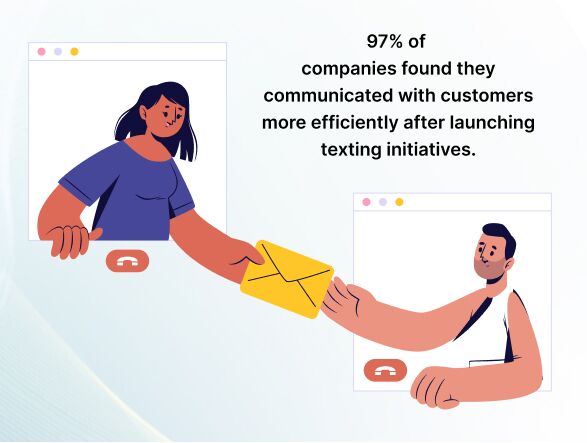
Businesses need to connect with customers directly to build stronger relationships. SMS allows personalized communication as businesses can include the customer’s name and tailored content based on their past interactions and preferences.
SMS is Cost-Effective
SMS is a cost-effective communication tool. The cost of sending bulk SMS is often cheaper than other marketing methods like direct mail or print media.
Texts Offer a Global Reach
We all know that SMS is a globally accessible communication medium. Regardless of the device and location, SMS offers a simple and effective way to connect with people around the world. Moreover, text messages don’t rely on data plans. Any mobile device with a network connection can send and receive text messages. Also, SMS can be used to send messages in various languages and character sets, making it suitable for international communication.
The Telecom Advantage: Why SMS for Telecommunication Companies Is Critical
Now let’s talk Telecom – these companies don’t just sell plans, they sell connectivity, reliability, and trust. And here’s the irony: the very industry that powers communication often struggles to communicate effectively with its own customers. That’s where SMS becomes not just useful… but critical.
SMS Works Even When Data Doesn’t
Telecom operators operate in unpredictable environments: Network congestion, temporary outages, low-data regions, roaming scenarios, rural coverage gaps, and a lot more. When mobile data is slow or unavailable, app notifications fail. Emails sit unread.
But SMS?
It works on the basic GSM network, doesn’t require the internet, and doesn’t require an app.
That reliability is a massive operational advantage.
Imagine a sudden service disruption affecting 200,000 subscribers. An SMS alert can instantly inform users about the issue and expected resolution time, reducing panic, inbound calls, and social media backlash.
Remember, in crisis communication, speed equals reputation protection.
It’s the Backbone of Security & Authentication
Answer this question – how often do you receive OTPs?
Whether you log in to your internet banking account, make SIM swaps, do app sign-ins, or approve transactions, OTPs land in your phone every now and then.
SMS is still the dominant channel for two-factor authentication globally. According to Gartner, multi-factor authentication adoption continues to grow rapidly as cyber threats increase, and SMS remains one of the most widely deployed methods.
For telecom companies, this is even more critical because:
- SIM activation requires verification
- Port-in/port-out requests need authentication
- Account changes must be secured
- Fraud alerts must be immediate
Without SMS, telecom security infrastructure becomes weaker and slower. To put it simply, we can say that SMS isn’t just marketing, it’s infrastructure-level security.
It Reduces Support Load Dramatically
Telecom call centers are expensive to operate. Every missed billing reminder or uncommunicated outage can trigger thousands of support calls.
Now consider this: If a telecom operator sends a timely SMS about:
- Upcoming bill due date
- Plan expiration
- Scheduled maintenance
- Network downtime
Customers are informed before frustration builds.
Research from McKinsey & Company consistently shows that proactive customer communication significantly reduces service costs and improves satisfaction scores.
It Drives Faster Revenue Cycles
Telecom revenue depends heavily on timely bill payments, plan renewals, data pack recharges, and upsell adoption.
And here’s where SMS becomes powerful. Unlike email, SMS is typically read within minutes, making it one of the most immediate communication channels available.
For telecoms, that means:
- Faster payment reminders
- Higher recharge completion rates
- Better response to limited-time offers
A simple SMS reminder saying:
“Your data plan expires today. Renew now to avoid service interruption.” can significantly increase same-day conversions. When multiplied across millions of subscribers, the revenue impact is substantial.
It Strengthens Customer Trust
Telecom customers don’t expect perfection. They expect transparency.
If there’s downtime, they want to know.
If charges change, they want clarity.
If their plan is expiring, they want a reminder.
Silence creates frustration. Clear communication builds loyalty. According to global customer experience insights published by Forrester, customers are more likely to stay with brands that communicate proactively and clearly during service disruptions.
SMS provides that direct, personal line. It feels immediate, official, and reliable. And for telecom brands, reliability is everything.
It Scales Across Millions Instantly
Telecom companies operate at scale. Not thousands of users. Millions.
SMS infrastructure is built to handle massive volumes quickly. Modern SMS communication platforms like REVE SMSC demonstrate how scalable A2P messaging can be when integrated into telecom systems.
Whether it’s a nationwide outage notification, a regulatory update, a holiday promotion, or a security alert, SMS can reach millions within seconds. Few channels offer that combination of speed, reach, and simplicity.
How Telecom Companies Can Successfully Implement Business SMS
Let’s be clear about something.
Launching business SMS isn’t difficult. Launching it strategically, at scale, compliantly, and profitably, is where telecom companies either succeed or struggle. For telecom operators, SMS isn’t just another marketing channel. It sits at the intersection of infrastructure, compliance, customer experience, and revenue operations.
Here’s how to implement it the right way.
Start With Clear Objectives
Technology is secondary here; therefore, before choosing an SMS platform, be clear about your goals.
Ask:
- Are we trying to reduce churn?
- Improve bill payment cycles?
- Lower call center volume?
- Strengthen authentication security?
- Increase ARPU through upselling?
Each objective changes how SMS should be structured. For example, If your goal is to reduce churn, your SMS program will focus on:
- Renewal reminders
- Plan expiry alerts
- Proactive service notifications
If your goal is to increase revenue, you’ll focus on:
- Data pack promotions
- Targeted upsell campaigns
- Personalized recharge offers
Remember, strategy comes first.
Build the Right Infrastructure
Telecom-scale messaging requires reliability. This means choosing:
- A robust SMS gateway
- Direct carrier connections
- High-throughput routing
- Redundancy systems
For telecom operators specifically, infrastructure should include:
- Direct SS7/SMPP connectivity
- Real-time delivery reporting
- Failover routing
- Smart retry mechanisms
Because at telecom scale, even a 1% delivery failure can mean thousands of customers not receiving critical alerts. Reliability is non-negotiable.
Ensure Compliance From Day One
Telecom messaging is heavily regulated. Depending on geography, companies must comply with:
- Opt-in/opt-out regulations
- Data protection laws
- Anti-spam policies
Failure here doesn’t just hurt deliverability. It can result in:
- Financial penalties
- Message blocking
- Brand reputation damage
According to insights published by Gartner, regulatory compliance is becoming a major operational priority for telecom and digital communication providers globally. Compliance should be built into the system, not treated as an afterthought.
Integrate SMS With Core Systems
Business SMS should not operate in isolation. It must integrate with CRM systems, billing platforms, and customer support tools.
For example:
When a customer’s bill is generated → SMS is triggered automatically.
When payment fails → SMS reminder sent within hours.
When the plan is about to expire → Automated renewal message is sent.
This requires API-level integration and event-based automation. Manual bulk sending is not implemented. Automation is.
Choose the Right SMS Numbers & Sender Strategy
When it comes to SMS numbers in business, there are various options to choose from. Let’s explore these options, one by one:
Short Codes
Short codes are 4 to 9-digit numbers used for high-volume messaging. The usage of such codes is usually done for marketing campaigns, bulk messaging, and mass notifications such as alerts and contests. Depending upon the number of messages a business is sending and the data rates of the network provider, short codes often cost a lot. An example of a short code can be 855-SHOP-NOW.
Long Codes
Long codes are standard 10-digit phone numbers suitable for low-volume messaging and two-way communication. In the context of business communication, long codes are often used for customer support. A prerequisite to using long codes for SMS communication is that the number must be registered to send business communication, wherein the registration process usually takes a couple of days or weeks. An example of a long code is (123) 456-7890.
Toll-Free Phone Numbers
Toll-free numbers are also long-form numbers (often 10-digit numbers), and they usually start with a prefix such as 800 or 888. Toll-free numbers allow customers to send and receive messages without incurring charges, enhancing customer convenience. Another upside of toll-free numbers is that they appear more professional than long codes.
10DLC
10DLC stands for 10-Digit Long Code. These phone numbers are regular phone numbers used for sending SMS messages on a larger scale. They are often used by businesses to communicate with their customers. A 10DLC number can look like this – +1 555 555 5555.
Dedicated Numbers
Dedicated numbers are exclusively assigned to your business, providing a consistent point of contact and improving brand recognition. However, these numbers can be used for various purposes such as support, sales, and marketing. It is important to mention that these numbers are not specifically designed for high-volume SMS campaigns. A simple example of a dedicated number is (555) 555-5555.
Probably you’re thinking about which phone number is best for SMS communication in business, right? Well, consider these factors and make an appropriate choice:
- The volume of messages you expect to send
- Your target audience
- Your brand image
For high-volume messaging or marketing campaigns, short codes may be the best option. For personalized customer support or two-way communication, long codes or toll-free numbers might be more suitable. Dedicated numbers are ideal for businesses that want to establish a strong brand identity and provide a consistent point of contact.
Segment and Personalize at Scale
Generic messaging is outdated. Telecom companies have access to rich data:
- Usage patterns
- Recharge frequency
- Plan preferences
- Geographic location
- Payment history
That data should power SMS segmentation.
Instead of: “Recharge now.”
Send: “Your 5GB monthly data pack expires today. Renew now to avoid interruption.”
Personalization increases response rates significantly. Research frequently cited across marketing studies shows SMS open rates often exceed 90%, making personalization within SMS even more impactful. When customers feel messages are relevant, they act faster.
Automate Proactive Communication
The most successful telecom operators don’t wait for customers to call. They anticipate needs.
Automation workflows can include:
- 3-day pre-expiry reminder
- Same-day payment alert
- Failed recharge notification
- Network maintenance update
- Fraud detection alert
Research from McKinsey & Company highlights that proactive customer communication significantly reduces support costs and improves customer satisfaction.
In telecom, every prevented support call saves operational expense. Automation isn’t just convenient. It’s cost control.
Continuously Optimize Messaging Strategy
Telecom markets evolve rapidly. Customer behavior changes. Regulations update. Competitors launch new offers.
Optimization should include:
- A/B testing message formats
- Testing send timing
- Monitoring route quality
- Reviewing template performance
- Updating personalization logic
Business SMS is not a “set it and forget it” system. It’s a dynamic communication engine.
ROI Breakdown: How SMS Becomes a Revenue Driver
At this point, the big question isn’t “Does SMS work?”
It’s: “Does SMS make money?”
For telecom companies operating at scale, the answer isn’t just yes – it’s measurable. When implemented strategically, business SMS directly impacts revenue, cost efficiency, and customer lifetime value. Let’s break down exactly how.
Faster Payment Cycles = Improved Cash Flow
Late payments hurt telecom operators more than most industries. Billing cycles are predictable. Revenue models are recurring. Even small delays across millions of subscribers can impact working capital.
Now consider this:
An automated SMS reminder sent:
- 3 days before the due date
- On the due date
- 24 hours after a missed payment
can significantly increase on-time payments.
Why? Because SMS is immediate. Industry studies consistently report SMS open rates above 90%, often within minutes of delivery. Compare that to email, which may sit unread for days.
If even 5% more customers pay on time because of SMS reminders, the cash flow improvement can be substantial at scale. That’s not marketing ROI. That’s financial efficiency.
Reduced Churn = Retained Revenue
Telecom churn is expensive. Acquiring a new customer costs far more than retaining an existing one. According to insights from McKinsey & Company, improving customer engagement and proactive communication plays a significant role in reducing churn across service industries.
SMS helps prevent churn in several ways: Plan expiry reminders, Personalized upgrade offers, Proactive outage notifications, Loyalty incentives, and win-back campaigns.
Imagine a telecom operator with 2 million subscribers and a 2% monthly churn rate. If SMS-based proactive engagement reduces churn by even 0.5%, that translates into thousands of customers retained and millions in preserved annual revenue. Retention compounds over time.
Increased Recharge & Upsell Conversions
Telecom revenue isn’t static. It grows through Data pack upgrades, Add-on services, roaming activation, and Value-added services.
SMS excels in driving short-term action. For example:
“Your data pack expires today. Add 5GB now at 20% off.” That urgency works because SMS is read almost instantly.
Campaigns that combine Personalization, Timely triggers, and Clear CTAs often outperform email and app notifications in response speed. When even a small percentage of users convert on upsell messages, the revenue lift becomes noticeable across large subscriber bases.
Lower Support Costs = Higher Margins
Revenue growth isn’t only about selling more. It’s also about reducing operational expense. Every inbound support call costs money.
Now imagine:
- A billing confusion that could have been clarified via SMS
- A service outage that triggered thousands of avoidable complaints
- A roaming activation issue that required manual support
Proactive SMS alerts reduce uncertainty. According to industry research cited by Gartner, proactive customer communication significantly improves satisfaction and reduces service interaction costs. If SMS reduces call center volume by even a small percentage, the cost savings directly improve margins.
Revenue + cost reduction = stronger ROI.
Fraud Prevention Saves Direct Financial Loss
Telecom fraud, SIM swaps, account takeovers, and suspicious transactions can lead to serious financial and reputational damage.
Real-time SMS alerts for SIM change requests, Password resets, and unusual activity allow customers to act immediately. Even preventing a small number of fraud incidents can protect substantial revenue. In this case, SMS isn’t just generating revenue. It’s protecting it.
Brand Trust Increases Customer Lifetime Value
ROI isn’t only transactional. It’s relational.
Telecom customers who receive Clear billing updates, Transparent outage notifications, Timely renewal reminders, and Personalized offers feel informed. And informed customers are less likely to leave.
According to global customer experience research from Forrester, proactive communication strongly influences loyalty and retention across digital service providers.
Longer retention = higher lifetime value (LTV).
Higher LTV = stronger long-term revenue.
The Compounding Effect at Telecom Scale
Here’s where things get powerful. At telecom scale, small improvements create a massive financial impact.
For example:
- 3% increase in on-time payments
- 0.5% reduction in churn
- 2% increase in data pack renewals
- 4% reduction in support calls
Individually, these seem modest. But across millions of subscribers? The impact compounds into millions in retained or additional revenue annually. That’s why SMS becomes more than a communication channel. It becomes a revenue system.
The Future of Business SMS in Telecom
If you think SMS is “old technology,” look closer. In telecom, SMS has quietly evolved from a basic notification tool into a strategic communication layer, and its future is far from stagnant.
The next phase of business SMS isn’t about volume. It’s about intelligence, integration, and infrastructure.
Here’s what’s coming next.
From Bulk Messaging to Intelligent Automation
The future of business SMS in telecom is deeply connected to automation and AI. Instead of sending scheduled campaigns, telecom operators are moving toward:
- Behavior-triggered messaging
- Predictive recharge reminders
- Usage-based upsell prompts
- Real-time churn risk alerts
For example:
If a subscriber’s data usage drops significantly over two billing cycles, the system can automatically trigger a personalized offer.
AI-driven communication isn’t theoretical. According to insights from Gartner, intelligent automation is rapidly transforming customer engagement models across service industries. In telecom, this means SMS becomes predictive, not reactive.
Hyper-Personalization at Scale
Telecom operators hold powerful datasets: network usage, roaming activity, device type, payment patterns, service preferences. The future of business SMS lies in using this data responsibly and intelligently.
Instead of: “Upgrade your plan.”
Subscribers will receive: “You’ve used 95% of your monthly 10GB data. Add 5GB now for uninterrupted streaming.”
This level of personalization increases conversion rates while improving customer satisfaction.
SMS + RCS: Richer Messaging Experiences
Rich Communication Services (RCS) is gradually reshaping what messaging can look like. Unlike traditional SMS, RCS supports:
- Branded sender profiles
- Interactive buttons
- Images and carousels
- Real-time responses
Major telecom players and technology companies like Google are supporting RCS adoption across Android ecosystems. For telecom companies, this means:
- Interactive bill payments inside messages
- One-tap recharge buttons
- Branded service notifications
- Rich promotional campaigns
SMS will continue to exist, but enhanced messaging experiences will expand engagement possibilities.
Stronger Security & Authentication Layers
With increasing cyber threats, telecom security will only tighten. SMS will continue playing a critical role in:
- Multi-factor authentication
- SIM swap alerts
- Fraud detection notifications
- Transaction verification
According to research frequently referenced by McKinsey & Company, digital trust and identity verification are becoming core priorities in telecom ecosystems. Even as alternative authentication methods emerge, SMS remains one of the most universal verification channels globally.
Deeper Omnichannel Integration
The future isn’t SMS versus other channels. It’s SMS integrated within an omnichannel ecosystem. Telecom operators will increasingly combine:
- SMS
- Email
- App notifications
- WhatsApp
- Chatbots
For example:
If an app notification fails → trigger SMS.
If SMS isn’t acknowledged → escalate via another channel.
SMS becomes the backbone fallback channel because of its near-universal reach. It acts as the reliability layer within omnichannel strategies.
Compliance & Transparency Becoming Competitive Advantages
Regulations around messaging are tightening globally. DLT frameworks, opt-in regulations, and anti-spam rules are expanding. Rather than viewing compliance as a restriction, forward-thinking telecom companies will treat it as a trust differentiator.
- Clear consent.
- Transparent communication.
- Verified sender IDs.
These will strengthen brand credibility in increasingly regulated markets.
Data-Driven Revenue Optimization
In the future, SMS won’t just send messages. It will feed analytics engines.
Telecom operators will analyze:
- Response rates by segment
- Time-of-day engagement trends
- Offer conversion patterns
- Churn-risk triggers
This data will continuously refine:
- Pricing strategies
- Offer timing
- Campaign structures
SMS becomes both a communication channel and a data feedback loop.
The Continued Power of Simplicity
Despite all technological evolution, one truth remains: SMS works everywhere. It doesn’t require Smartphone upgrades, High-speed internet, and App installations. That simplicity is its strength.
In emerging markets, rural regions, and roaming environments, SMS remains one of the most inclusive communication channels available. As telecom companies expand into diverse geographies, this universality keeps the SMS future-proof.
REVE SMS Platform: A Telco-Grade SMS Solution for Your Business

A comprehensive SMS solution for companies looking for efficient and cost-effective SMS communication, the REVE SMS platform supports Application-to-Person, Person-to-Application, and Person-to-Person SMS traffic. REVE SMS brings a wide range of powerful features that can help you run successful SMS campaigns. Companies can send a wide range of message types, including promotional, bulk, transactional, and response-driven SMS. You can avail the solution either through licensing or a hosted model. A free demo can help you understand better.
Conclusion
SMS for business communication offers a powerful, versatile, and cost-effective way to connect with customers, employees, and stakeholders. By leveraging the advantages and features of business SMS solutions and following best practices, businesses can enhance their communication strategies, drive engagement, and achieve better outcomes. Embrace SMS as a key component of your communication toolkit and experience the benefits of instant, direct, and personalized messaging.
Frequently Asked Questions