HLR Lookup: How it Improves SMS Delivery & Data Accuracy?
- February 27, 2026
- 11 Mins Read
- Listen

In the SMS world, the delivery accuracy is an important aspect. Besides being a technical metric, it signifies the reputation, customer experience, and the ROI of a business. When a business sends a transactional alert, it expects that SMS to reach the right subscriber instantly. From the front, it may look like a very simple process, but behind that “message sent” notification lies a complex telecom process. And this is exactly where HLR lookup in SMSC routing plays its role.
In a large-scale messaging environment, the importance of routing a message correctly on the first attempt is highly critical. Especially for SMS aggregators, routing failures are simply unaffordable. By performing an HLR lookup before routing, the SMSC gains real-time intelligence about the subscriber’s network, enabling smarter routing decisions, higher delivery accuracy, and improved margin control.
In this post, we are going to understand the importance of accurate HLR data and how HLR lookup adds the intelligence that makes SMS routing faster, smarter, and more reliable. This is valualbe post for aggregators, telecom operators, and enterprises that depend on high-volume, high-accuracy messaging.
Let’s begin.
What Is HLR in Telecom?
HLR stands for Home Location Register. In the world of telecom networks, subscriber data plays a very core role, and HLR acts as a central subscriber database within a mobile network. An HLR is like a database that stores “identity and status record” for every mobile number registered under a telecom operator. If there is no HLR, then the network wouldn’t know who you are, which services you’re allowed to use, or even where to route calls and messages meant for you.
A practical example helps understand better, right? So let’s make this practical.
Suppose you insert a new SIM card into your mobile phone and turn it on. At this point, the mobile network checks your subscriber details stored in the HLR and confirms that it recognizes you. The HLR database contains critical information about the subscribers, such as:
- Your mobile number (MSISDN)
- Your IMSI (International Mobile Subscriber Identity)
- Your current network operator
- Whether your number is active
- Your roaming status
- The services enabled on your SIM (SMS, voice, data, etc.)
So basically, HLR is the telecom network’s source of subscriber intelligence, i.e., how to reach the subscriber.
What is an HLR Lookup?
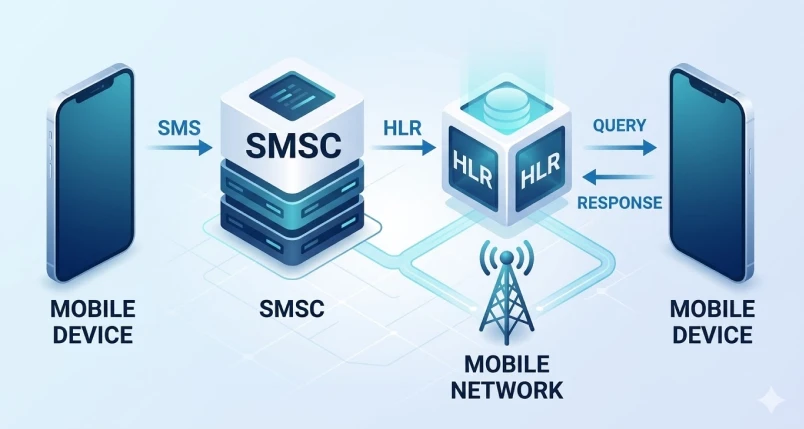
An HLR lookup is a telecom process performed to retrieve real-time information about a mobile number directly from the operator’s subscriber database. An HLR lookup answers an important question: What is the current status and serving network of this mobile number? When a mobile number is entered into an HLR lookup system, the service sends a signaling request into the telecom network to query the subscriber’s home database (HLR in GSM networks, or HSS in modern LTE/5G networks). The network then responds with technical details about that number.
These details can include:
- Whether the number is active or inactive
- The current serving mobile network operator (MNO)
- Whether the number has been ported (Mobile Number Portability)
- Roaming status
- Network country information
- Subscriber reachability status
This is what makes HLR lookup different from simple number validation tools. Basic validation only checks formatting, length, and prefix patterns. An HLR lookup goes much deeper; it interacts with the telecom signaling infrastructure to obtain live network data.
It’s important to note that HLR lookup does not reveal personal subscriber information like name, address, or message content. It strictly retrieves network-level data required for routing and validation.
How Does HLR Lookup Detect the Current Operator of a Number?
This is a very common question that appears when people first learn about HLR lookup. While there are hundreds and thousands of telecom operators globally, how does an HLR lookup system know where exactly to send the query?
When an HLR lookup request is initiated, the system doesn’t immediately jump into querying a telecom network. Rather, it performs a very careful evaluation of the phone number to determine whether it even makes sense structurally.
It starts with basic validation checks. The system examines whether the number includes a legitimate country code. It then verifies that the total number of digits matches the expected length for that specific country. Once this is done, it moves further to check whether the areas or network prefix is actually assigned within that country’s numbering plan. With success to all that, it finally confirms that this prefix is officially allocated to a recognized network operator and treats the number as structurally valid.
Then the system starts over with the next phase, in which it determines what kind of number it is. Different countries use defined numbering ranges to distinguish between mobile phones, landlines, paging services, VoIP numbers, and sometimes even special-use ranges. For example, certain number blocks are reserved purely for fictional or media purposes, like the well-known 555 range frequently used in movies and television in the United States.
The next step is crucial. After identifying the number type, if the number falls within a mobile range, the HLR lookup checks whether the originally assigned mobile network operator (MNO) is reachable through routing. Being “in routing” means the lookup system has an active signaling path to that operator and can send a network query expecting a valid response. If the operator is accessible, the system proceeds with the HLR query to retrieve subscriber details.
How HLR Lookup Works: Step-by-Step
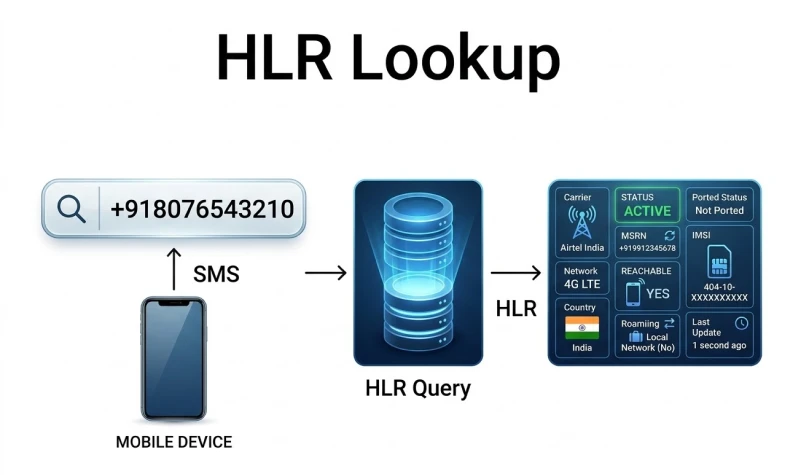
The next question is quite logical and obvious – what happens when an HLR lookup is performed from beginning till end? From the outside, the process looks quite simple. A system checks a mobile number and returns operator details. But behind the scenes, a structured process is happening.
Let’s break it down:
Step 1: The Mobile Number is Submitted
The process starts with the verification of an MSISDN, i.e., the mobile number of the subscriber. So before routing a message, the system triggers an automatic HLR lookup service. This usually happens via API. Here, the lookup service prepares to query the telecom network for real subscriber information.
Step 2: The Network Query is Initiated
After number submission, the HLR lookup service sends a signaling request to the telecom network using SS7 or Signaling System No. 7, which is the protocol that allows telecom networks to exchange subscriber data. This query is directed toward the operator’s HLR
Step 3: The HLR Responds with Subscriber Data
The HLR then checks its records and responds with relevant details. The response usually includes subscriber identity or the IMSI, current serving operator, roaming status, status of the number, and ported number information. This means there is no scope for guesswork based on old numbering patterns; the system now knows the actual current network serving that subscriber.
Step 4: The Lookup Service Processes the Data
Once the HLR responds, the lookup service translates the technical signaling data into usable information. Here’s an example :
- Operator: ABC
- Country: XYZ
- Status: Active
- Roaming: No
This processed data is then sent back to the requesting system, whether it’s an SMS platform, aggregator, or enterprise application.
Step 5: The SMSC Makes a Smarter Routing Decision
Here comes the real thing. Now that the SMSC has the accurate operator and status information, it can choose the most suitable route to deliver the message. This means that instead of sending traffic through an outdated operator route, paying for failed delivery attempts, and experiencing delays, the SMSC now routes the message directly to the correct serving network.
This helps in improving delivery rates, speed, cost efficiency, and overall routing accuracy.
Step 6: Continuous Optimization at Scale
The most amazing thing about HLR lookup is that the whole process happens automatically and instantly, often within milliseconds, even in high-volume environments. For SMS aggregators who send millions of messages daily, the HLR lookup process helps in removing inactive numbers, detecting ported numbers, preventing routing losses, and improving margin control.
Why Businesses Use HLR Lookup Services
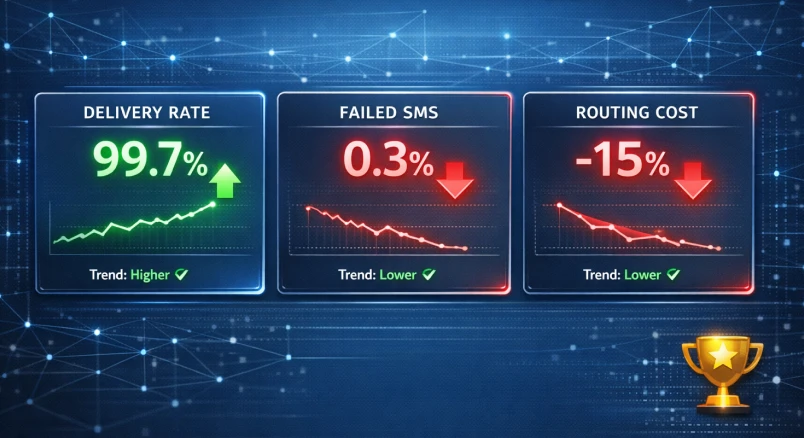
A business that sends just a few messages a day might skip HLR lookup. But for those sending SMS campaigns at scale, i.e., sending thousands, millions, or even tens of millions of SMSs, HLR lookup simply becomes essential. Let’s take a deep look at why businesses invest heavily in HLR lookup:
First, HLR lookup helps businesses improve the delivery accuracy of their SMS campiagns. Imagine a company sending its festive discount offers via SMS. But what if most of their messages are directed to inactive, ported, and unreachable numbers? Without having a proper validation, they’re just paying money to send SMS messages into a black hole. HLR lookup helps in solving this problem by verifying whether a number is active and the operator currently serving it. So from the very beginning, the messages are routed to the correct addresses.
Secondly, HLR lookup helps businesses in saving money that would otherwise be expended in failed routing attempts or even sending messages via expensive routes. In A2P messaging, the cost of sending SMS messages varies depending on the destination network and country.
Suppose a mobile number is ported to a different operator, but the routing is not updated; the message would either be undelivered or routed through a costly route. When this happens on a large scale, the business’s profit margins are directly affected. Performing HLR lookup before routing helps aggregators and enterprises to avoid unnecessary interconnect charges and failed delivery costs.
Thirdly, database cleansing is another major benefit that businesses reap from HLR lookup. Subscriber databases are bound to degrade over time. This happens because customers change their phone numbers, deactivate SIM cards, or switch operators. If companies continue to send SMS messages to the same old customer databases, they are likely to waste a lot of money and risk damaging their reputation as well.
HLR lookup allows businesses to periodically clean their contact lists by identifying inactive numbers, disconnected SIMs, invalid numbers, and ported numbers. Running SMS campaigns using healthy databases simply improves the effectiveness of a business’s marketing efforts.
Then comes the importance of time-sensitive messaging, especially in industries like banking, healthcare, and e-commerce, where a delay of a few seconds can impact customer experience badly. HLR lookup ensures that the SMSC routes messages through the correct operator immediately, reducing retries and optimizing delivery.
Another important reason is fraud prevention, but it is often overlooked. HLR can also help businesses in detecting artificial traffic patterns, suspicious bulk registrations, or numbers that do not match expected operator or region data. Through HLR lookup, the subscriber data gets validated in advance to reduce fraudulent activity and protect infrastructure.
HLR Lookup for SMS Aggregators & Enterprises
The fact that SMS aggregators and enterprises operate differently when it comes to large-scale messaging, but at the same time, both rely heavily on HLR lookup for delivery performance optimization and profitability.
Let’s first talk about SMS aggregators.
Aggregators are the bridge between enterprises and mobile network operators. They handle massive volumes of A2P SMS traffic on a daily basis, where messages are routed across multiple countries and networks. Their margins are often very tight, and routing efficiency significantly matters to them. Even a small percentage of failed or misrouted traffic can turn into substantial revenue losses.
So for SMS aggregators, HLR lookup is not merely a validation feature but a core operational tool that decides their survival in the market.
Now, let’s turn to enterprises.
Whether it is a bank, an e-commerce platform, or a fintech company, it is often seen that they focus more on customer experience and care less about telecom routing mechanisms. However, the impact of HLR lookup is equally critical for them
For example, an OTP sent by a bank should typically reach the customer instantly. However, if the number has been ported anda delay occurs, it can frustrate customers. HLR lookup ensures that the message reaches the correct operator immediately, improving speed and reliability.
Key Takeaway!
HLR lookup plays a critical role in optimizing SMSC performance by ensuring messages are routed only to valid, active, and reachable mobile numbers. By verifying subscriber status in real time, businesses and telecom operators can significantly reduce message failures, lower operational costs, and improve overall delivery rates.
Whether it’s for bulk SMS campaigns, OTP authentication, or fraud prevention, integrating HLR checks within an SMSC environment enhances reliability and efficiency across messaging operations. Modern messaging ecosystems, including advanced platforms like REVE SMS, increasingly incorporate intelligent validation and routing mechanisms to help operators maintain high-quality delivery standards while maximizing ROI. A free personalized demo of our SMS platform will help you understand things better!
Frequently Asked Questions