Call Center Metrics: KPIs, Calculations & Industry Benchmarks
- February 17, 2026
- 15 Mins Read
- Listen

Not too long ago, the success of any contact center was measured mainly by three aspects: the number of calls answered, how busy the agents were, and customers talking just nicely over the calls. Call center metrics were nothing but just numbers.
However, that way of running and measuring a successful call center doesn’t exist anymore. Today, customer expectations have changed – they want fast resolutions, minimal wait times, and a consistent experience across channels. Even call center leaders want visibility into performance, costs, and outcomes. Moreover, agents, who are the frontiers, expect the right support to stay productive without burning out.
In such an environment, it becomes highly important to track the right metrics to know what’s really happening inside your call center operations. This means you need to have a clear understanding of which contact center metrics actually matter and how they are related to your CX, agent productivity, and operational expenses.
In this post, we’ll help you understand everything in a very simple, practical way. You’ll get to learn which KPIs to track, how to calculate key metrics, what industry benchmarks look like, along with some real-world examples.
What Are Call Center Metrics?
Call center metrics are the data or the real numbers that tell a business about how its contact center is actually performing. We all know that call centers operate in a very dynamic environment. There is a lot of buzzing due to different activities like incoming calls, agents talking to customers, issues getting resolved, calls being transferred here and there, customers hanging up frustrated or happy. Call center metrics help turn all these activities into actionable insights, i.e., what happened, why it happened, and what to fix next.
Did you know: 63% of customers will switch brands after poor customer service.
By using call center metrics correctly, you can make smarter staffing decisions, improve customer experience consistently, support agents instead of burning them out, and find the real value of your call center to the business.
Call Center Metrics vs Call Center KPIs

For many in the call center industry, call center metrics and call center KPIs may sound like the same thing and are often used interchangeably. But the truth is something else: all KPIs are metrics, but not all metrics are KPIs. Understanding this difference will help you track the right numbers rather than being puzzled by dashboards with random figures.
What Call Center Metrics Really Are
Call center metrics are the activities or operations that you can measure in your contact center. These metrics give you raw data points about what is happening, but they don’t tell you whether something is right or wrong. Some of the most common call center metrics include :
- Total Calls Received
- Average Handle Time
- Hold Time
- After-Call Work
- First Call Resolution
- Call Abandonment Rate
- Agent Occupancy
- Repeat Call Rate
- Customer Wait Time
- Transfers Per Call
What Makes a KPI Different?
KPIs stand for Key Performance Indicators. These are a select few metrics that tell you whether you are moving in the right direction or not. In other words, we can say that KPIs are the call center metrics that are directly linked to your unique business goals. For example, if your business goal is to reduce repeat calls, then FCR or First Call Resolution becomes a KPI for you.
Business leaders and supervisors need to understand that they need both call center metrics and KPIs, but at the same time, they need to use them differently. While call center metrics provide them with visibility into their operations, KPIs help them focus on their goals.
Key Categories of Call Center Metrics
If you start searching for call center metrics, you will be simply overwhelmed because the list is endless. But we have some good news: they all fall into a few clear categories, which are easy to understand. Once you get clarity about these categories, metrics won’t look random anymore.
1. Customer Experience Metrics
Metrics under this category tell you one thing about your call center: How do customers feel after interacting with your call center? In short, it tells you about the customer experience. Common customer experience metrics include:
- Customer Satisfaction Score (CSAT) – Measures how satisfied customers are after a call or interaction
- Net Promoter Score (NPS) – Indicates how likely customers are to recommend your brand
- Customer Effort Score (CES) – Shows how easy or difficult it was for a customer to get help
- First Call Resolution (FCR) – Tracks whether the issue was resolved in the first interaction
The importance of these call center metrics lies in the fact that they tell you whether your customers are happy or frustrated. And since these metrics directly impact retention and revenue, they are often used as call center KPIs these days.
2. Operational Efficiency Metrics
These metrics tell you about how smooth the ‘behind-the-scenes’ things are in your call center. Some of the most common and useful operational efficiency metrics are:
- Average Handle Time (AHT) – Average duration of a customer interaction
- Average Speed of Answer (ASA) – How long customers wait before an agent responds
- Service Level – Percentage of calls answered within a target time
- Call Abandonment Rate – Percentage of callers who hang up before reaching an agent
- Queue Time – Time customers spend waiting in line
These metrics help you understand whether your staffing, scheduling, and call routing are balanced or need optimization.
3. Agent Performance Metrics
These metrics revolve around your agents, i.e., how effectively they are handling customer interactions. Some of the most common metrics in this category include:
- Calls handled per agent
- Average Handle Time per agent
- After-Call Work (ACW) time
- Adherence to schedule
- Quality assurance (QA) scores
Having these metrics helps supervisors to find out agents who need training and guidance, who are overloaded with work, and who are ready to take advanced roles.
4. Call Volume & Traffic Metrics
As the term indicates, these metrics give you a picture of how many interactions your call center is dealing with and when. Common call volume metrics include
- Total calls received
- Peak call hours
- Call arrival rate
- Calls by issue type
- Repeat call volume
The importance of these metrics comes in when call centers need to make workforce planning and forecasting.
5. Quality & Compliance Metrics
These metrics answer one question often asked by supervisors: Are conversations meeting quality, policy, and compliance standards? Some common quality and compliance metrics are:
- Call quality scores
- Script adherence
- Compliance violations
- Sentiment analysis
- Silence or interruption rates
Quality metrics help businesses ensure that agents follow processes, communicate clearly, and remain compliant. This is highly important in regulated industries like banking, healthcare, and telecom.
6. Cost & Productivity Metrics
Last but not least, every business wants to know whether its call center is cost-effective and sustainable. Well, the cost and productivity metrics help them understand the same.
Common cost and productivity metrics include:
- Cost per call
- Cost per contact
- Agent occupancy rate
- Utilization rate
- Revenue per call (for sales)
They help leadership understand whether the call center is scaling efficiently, generating ROI, overstaffed, or understaffed.
Call Center Metrics Calculations

Now we have a fair understanding of call center metrics, but that’s just one thing. Knowing how these metrics are calculated is where the real game begins. Let’s walk you through the individual call center metrics calculations in a very simple way:
1. Average Handle Time (AHT)
It is the average time an agent spends handling a customer interaction from start to finish. Don’t think that AHT is just the call duration; it is everything an agent does because of the call, including talking, placing the caller on hold, and wrapping things up afterward.
Formula for AHT:
Average Handle Time = (Total Talk Time + Total Hold Time + Total After-Call Work) ÷ Total Number of Calls
What Does High AHT Mean?
If your AHT is high, it could mean that calls are complex, agents might need better tools or coaching, or after-call work is consuming time.
2. First Call Resolution (FCR)
It is the metric that tells you how often customer issues are resolved in the first interaction, with no callbacks or follow-ups. A longer call that fully resolves the issue is usually better than a short call that leads to a callback.
Formula for FCR:
First Call Resolution (%) = (Number of Issues Resolved on First Contact ÷ Total Number of Issues) × 100
What does High FCR mean?
High FCR means your contact center is solving customer problems right the first time, efficiently, effectively, and without repeat effort.
3. Average Speed of Answer (ASA)
It is the metric that tells you how long customers wait before they are connected to an agent. This is mainly useful to diagnose staffing and scheduling issues. A good average speed of answer (ASA) is around 28 seconds. Source
Formula for ASA:
Average Speed of Answer = Total Waiting Time for Answered Calls ÷ Number of Answered Calls
What does high ASA mean?
High ASA means customers are waiting longer before their calls are answered by an agent.
4. Call Abandonment Rate
It is the metric that tells you about the percentage of callers who hang up before speaking to an agent.
Formula for CAR:
Call Abandonment Rate (%) = (Number of Abandoned Calls ÷ Total Incoming Calls) × 100
What does a high CAR mean?
A high abandonment rate is often linked to long wait times, poor IVR design, and mismatched staffing levels.
5. Service Level
It is the metric that tells you how consistently your call center meets response-time targets. It reflects how well your center delivers on customer expectations.
Formula for SL:
Service Level (%) = (Number of Calls Answered Within Target Time ÷ Total Answered Calls) × 100
What does SL calculation mean?
An SL of “80/20” means 80% of calls are answered within 20 seconds.
6. After-Call Work (ACW)
It is the metric that tells you about the time duration agents spend completing tasks after a customer call ends.
Formula for ACW:
Average ACW Time = Total After-Call Work Time ÷ Total Number of Calls
What does a high ACW mean?
Excessive ACW often signals that your call center is heavily relying on manual processes, systems are not effectively integrated, and the documentation process is overly complex.
7. Agent Occupancy Rate
It is the metric that tells you how much of an agent’s logged-in time is spent actively handling calls. It helps in identifying whether your agents are overworked, underutilized, or scheduled incorrectly.
Formula for AOR:
Occupancy Rate (%) = (Total Handle Time ÷ Total Logged-In Time) × 100
What does high AOR mean?
High occupancy rate looks good, but excessively high is a clear indication of burnout. It is always good to aim for balance.
8. Cost Per Call
This metric tells you about how much each customer interaction costs the business. Costs usually include agent salaries, technology and software, telecom charges, facilities, and overhead.
Formula for CPC:
Cost Per Call = Total Call Center Operating Costs ÷ Total Number of Calls
What does the CPC calculation mean?
CPC calculation is helpful when evaluating automation ROI, Outsourcing decisions, and channel shift strategies.
9. Customer Satisfaction Score (CSAT)
Another important metric that tells you how satisfied customers are after interacting with your call center.
Formula for CSAT:
CSAT (%) = (Number of Positive Responses ÷ Total Survey Responses) × 100
What does high CSAT mean?
CSAT is usually calculated on a 0 to 5 point scale. A rating of 4 or 5 is generally considered positive.
Call Center Metrics Industry Standards & Benchmarks
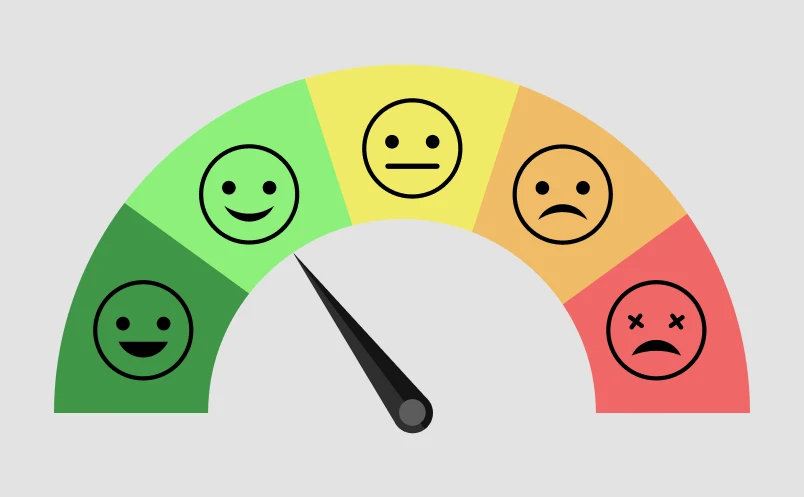
In the above section, we learned about calculating call center metrics, eventually these calculations lead managers and business leaders to one simple question: Are our numbers good or not?
This is where the role of industry standards and benchmarks comes in. Benchmarks give you context. A 6-minute Average Handle Time might sound high, until you realize your industry average is 7 minutes. A 75% service level might seem acceptable until competitors are operating at 85%.
Without benchmarks, metrics are just numbers. With benchmarks, they become performance indicators. It is important to understand that there is no universal perfect number; benchmarks vary based on different factors, including the type of industry, channel of communication, call complexity, customer expectations, and so on.
Here are some practical industry ranges that will give you an idea about how it works in real-life scenarios:
1. Service Level
Common Industry Benchmark:
80% of calls answered within 20 seconds (often referred to as 80/20). This is one of the most widely cited standards in contact centers. But it’s not a rule carved in stone. If you’re consistently below 70%, customers are probably feeling the wait.
If you’re pushing 95%, you may be overstaffed.
2. Average Speed of Answer (ASA)
Typical Industry Benchmark:
20–30 seconds for voice support. For chat support, expectations are often even shorter, sometimes under 15 seconds.
However, acceptable wait times depend on customer expectations. In industries where issues are urgent, like healthcare or telecom outages, a lower ASA is critical. In less urgent environments, customers may tolerate slightly longer waits.
3. Average Handle Time (AHT)
General Benchmark Range:
4 to 8 minutes for voice calls (varies significantly by industry). Simple transactional queries, like balance checks or order tracking, fall on the lower end.
Technical troubleshooting or B2B support calls naturally take longer. Here’s the mistake many call centers make: trying to aggressively reduce AHT without considering First Call Resolution.
AHT should never be optimized in isolation. A slightly longer call that solves the issue completely is often better for overall performance.
4. First Call Resolution (FCR)
Strong Industry Benchmark:
Generally, it is 70%–75%. However, for high-performing centers: 80%+.
An FCR below 65% is not considered healthy. Shockingly, only about 5% of call centers reach a world-class FCR of ≥80%.
5. Call Abandonment Rate
Healthy Benchmark:
5% or lower is normal. Above 8–10%, customers are likely hanging up out of frustration.
That said, many centers exclude “short abandons” (calls dropped within the first few seconds), since those may be accidental dial-outs.
6. Customer Satisfaction (CSAT)
Strong Benchmark:
75%–85%
Top-tier support centers: 90%+
CSAT benchmarks vary widely depending on industry. Premium service industries often aim for 90%+, while high-volume support environments may average slightly lower.
7. Agent Occupancy Rate
Typical Range: 75%–85%
Below 70% may indicate underutilization.
Above 90% can lead to burnout.
8. Cost Per Call
This varies widely depending on geography, technology stack, and labor model.
Globally, voice interactions can range anywhere from:
$2 to $10+ per call (depending on region and complexity).
Outsourced or automated environments may reduce this significantly, especially when AI or self-service tools are integrated.
How AI and Analytics Are Changing Call Center Metrics

Traditional call centers were quite rigid – calls came in, agents answered, data was logged into dashboards – that’s it. Managers relied on static reports, which were mainly spreadsheets filled with numbers. This data helped supervisors with what happened yesterday, but they remained clueless about why it happened or what was about to happen next.
Recently, a call center employee shared this on Reddit:
“Despite consistently delivering high-quality customer service, I find myself struggling to keep up with the speed required in a call center environment… I’m really good at de-escalating tense situations… but meeting the fast-paced metrics expected in a call center has been difficult… Imagine your boss literally over your shoulder every minute, telling you to move faster, do better, push harder – that’s what it feels like.”
The lines above don’t describe a person who is underperforming; rather, it’s someone trying their best to deliver quality, empathy, and resolution, but still feeling like they’re failing.
In the conventional way of performance measuring, speed-driven KPIs such as AHT, Calls Per Hour, and After Call Work duration were considered. But these operational numbers were monitored without context and don’t reflect the full story. This rigid way of evaluation becomes a source of stress for agents, making them feel pressured instead of supported.
Today, AI-based call center software has completely changed that scenario. Modern AI-driven platforms analyze data in real time and generate live insights. This means supervisors do not need to wait for end-of-day reports; they get instant access to metrics.
One amazing thing is that AI brings in powerful features of Speech Analytics, Sentiment Detection, and Behavioral Tracking into call center software. This means instead of measuring CSAT only through surveys, AI analyzes tone, language, and emotional cues during the conversation itself and generates insights accordingly. Even call abandonment rates are not just reported; they’re predicted.
This shift fundamentally changes how metrics function inside a call center. Average Handle Time, CSAT, FCR, and Service Level still matter. Traditional call centers used metrics to monitor operations. AI-driven call centers use metrics to guide operations.
The Reddit employee asked, “There must be a better way.”
There is.
AI and advanced analytics are no longer just efficiency upgrades; they are workforce sustainability tools.
Without intelligent systems:
- Metrics create burnout
- Supervisors rely on incomplete data
- High-empathy agents feel penalized
- Turnover increases
With AI-powered platforms:
- Metrics become balanced
- Quality and speed are measured together
- Coaching becomes personalized
- Performance becomes predictable
- Agents feel supported, not monitored
The modern contact center is not about pushing agents to move faster. It’s about equipping them to perform smarter. And in today’s high-volume, multichannel environment, adopting AI-driven metric tracking isn’t a luxury anymore.
It’s a necessity.
Key Takeaway!
Organizations that embrace modern, AI-driven call center analytics don’t just improve average handling time or reduce abandonment rates; they enhance customer loyalty, boost agent productivity, lower operational costs, and create measurable business impact. In a competitive market where customer experience defines brand value, tracking the right metrics with the right technology isn’t optional anymore; it’s essential for sustainable growth.
Connect with us to get expert guidance.
Frequently Asked Questions