How International Roaming Works: A Simple Guide
- April 6, 2026
- 16 Mins Read
- Listen

What’s that one thing that is super important for you the moment you land in a different country? For most people, it’s staying connected, whether it’s booking a cab, informing family you’ve arrived safely, checking maps, or responding to work messages. In today’s always-on world, global connectivity has become a basic need rather than a luxury. This is where international roaming (or global roaming) plays a crucial role, allowing your mobile network to keep working even when you’re miles away from home. While it feels seamless on the surface, there’s a lot happening behind the scenes to make that instant connection possible.
In 2026, both users and telecom operators care more than ever about how this experience is delivered. Users expect fast, reliable, and cost-effective connectivity without any hiccups, while telcos are under constant pressure to manage costs, prevent fraud, and ensure high-quality service across networks. In this blog, we’ll break down how international roaming works, explore the key challenges faced by users and operators, and look at the modern solutions that are transforming the global roaming experience.
What is International Roaming? The Concept
Roaming means that when a mobile user travels outside their home network’s coverage area, i.e., when they connect to a ‘visiting network’, they can still make calls, send messages, use the internet, and access other services which they were using in their home network.
In other words, we can say that international roaming is the technology that maintains seamless connectivity between the user’s home network and a foreign network, also called the host network or the visited network.
The next thing that comes to mind is: who is behind the process of international roaming? Well, your mobile network operators are the ones who provide you with international roaming services. Now, imagine what will happen if your mobile service provider does not offer international roaming?

As you travel across the borders, you’ll experience several challenges in connectivity, including:
- Not able to make and receive calls, access SMS, and use mobile data services.
- You’ll have limited communication options: either you have to get a local SIM card or rely solely on Wi-Fi
- Missed calls from friends, family, colleagues, and clients
- Delay in response due to dependency on alternate solutions
What is Global Roaming? Is It Different from International Roaming?
You might have come across the term global roaming and wondered whether it is just another name for international roaming, or something different. In simple terms, global roaming refers to the ability to stay connected across multiple countries worldwide using a single mobile connection. It emphasizes broader, worldwide coverage rather than just crossing into one specific country.
Now, when it comes to global roaming vs international roaming, there’s honestly very little difference in how they work. Both allow you to use your mobile services outside your home network by connecting to a foreign (visited) network. The difference is mostly in how the terms are used. International roaming is the more commonly used technical term in telecom, often referring to roaming between specific countries. Global roaming, on the other hand, is more of a marketing or user-friendly term used by operators to highlight wide, multi-country coverage plans.
In the industry, telecom providers, documentation, and technical discussions usually stick with international roaming. But when you see mobile plans advertised as offering “global roaming,” it typically means the service works across many countries under a single plan or package. So, while the terms may sound different, they essentially point to the same concept – keeping you connected wherever you go, just with a slightly different emphasis.
How Does International Roaming Work?
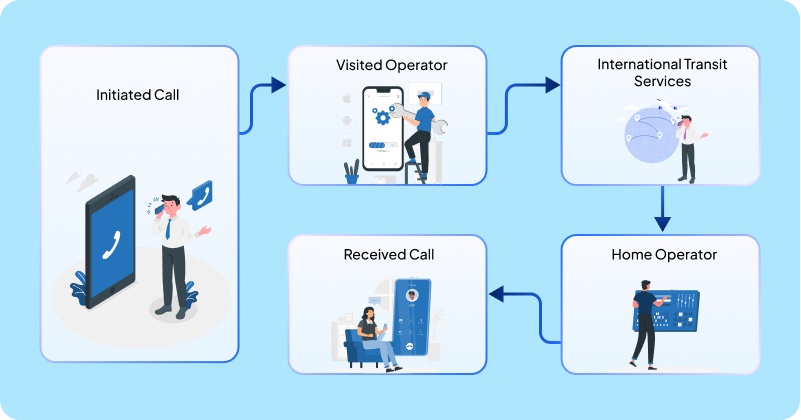
So, how does international roaming actually work the moment you land in another country and switch off airplane mode? It may feel instant, but there’s a whole process happening in the background within seconds. Let’s break it down in a simple, step-by-step way.
Device Detection and Network Selection
As soon as your phone turns on, it starts searching for available networks in that country. It automatically picks a compatible local network. This is called the visited network, based on the agreements your home operator has in place.
Authentication (SIM verification)
Once connected, your SIM card needs to be verified. The visited network checks with your home network to confirm that your number is valid and that roaming is enabled on your account. This SIM authentication step ensures secure access and prevents unauthorized usage.
Location Update
After verification, your location is updated in the system. Your home network now knows which country and network you’re currently on. This is important so incoming calls, messages, and data requests can be correctly directed to you.
Call, SMS, and Data Routing
Now comes the actual usage part. When you make a call, send a message, or use mobile data, the request travels through the visited network but is still managed by your home network. This coordination between networks ensures everything works just like it does back home, only across borders.
Billing and Charging
Finally, all your usage is tracked. The visited network records your activity and shares it with your home operator through a process called clearing and settlement. Based on roaming agreements between operators, charges are calculated and later reflected in your bill or deducted from your balance.
All of these steps work together to give you that seamless “it just works” experience when you travel abroad.
Key Technologies Behind Roaming
There are several technologies quietly working together to make sure your calls go through, your messages get delivered, and your data keeps flowing without a hitch.
First, there are signaling protocols like SS7 and Diameter. Think of these as the communication systems that networks use to “talk” to each other. They handle things like verifying your SIM, locating your device, and making sure your calls or data sessions are routed correctly. While SS7 has been around for years and is still widely used (especially in older networks), Diameter is the more modern protocol designed for faster, more secure communication in 4G and 5G environments.
Then comes the role of mobile networks themselves, evolving from 2G all the way to 5G. Roaming isn’t limited to just one generation; your phone can roam across different network types depending on availability and compatibility. For example, you might be on a 5G network in one country but switch to 4G or even 3G in another, and roaming still works. This flexibility is what ensures you stay connected, even if network technologies vary across regions.
Lastly, it’s important to understand the difference between data roaming and voice roaming. Voice roaming focuses on making and receiving calls using traditional telecom infrastructure, while data roaming is all about internet access: browsing, apps, emails, and more. Data roaming has become especially important in recent years, as most users rely heavily on mobile data rather than just calls or SMS.
Together, these technologies create the seamless roaming experience we often take for granted.
International Roaming vs National Roaming
Roaming isn’t always about crossing countries. You might have experienced it even within your own country. But international roaming and national roaming are quite different when you look closely. Let’s simplify it.
Domestic or National roaming is a service that allows mobile users to access mobile phone services outside their home network but within their home country. Domestic roaming services operate within the boundaries of the home country. These services are often available at lower costs.
On the other side, international roaming is a service that allows users to access mobile phone services outside their home country’s network, i.e., when they travel across borders. International roaming operates across different regions or countries. The costs for these services are usually high due to international carrier agreements and cross-border infrastructure use.
The primary goal of both types of roaming services is the same, i.e., to enable seamless connectivity. However, they differ significantly in terms of coverage, costs, and operational complexity. Let’s take a look at the table below that highlights the key differences between them for better understanding.
| Feature | National Roaming |
International Roaming
|
| Definition | Using your mobile phone on a network other than your home network within your home country. |
Using your mobile phone on a network in a foreign country.
|
| Coverage Area | Within your home country, but outside your home network’s primary coverage area. |
In a foreign country.
|
| Network Used | Partner networks within your home country. |
Partner networks in the foreign country.
|
| Charges | Typically lower than international roaming; often included in many modern unlimited plans. |
Generally higher charges due to complex international agreements between providers.
|
| Data Usage | May be subject to data caps or reduced speeds depending on the carrier agreement. |
Often subject to high per-megabyte charges. Using local SIMs or Wi-Fi is highly recommended.
|
| Activation | Usually automatic when you move outside your home network’s signal range. |
Often requires manual activation or the purchase of an international pass through your provider.
|
Major Challenges in International Roaming
Did you know that “10-20% of travelers do not connect to mobile networks at all when abroad. This is often due to high roaming charges or unreliable connectivity.” Source – OpenSignal
It is quite clear that an international traveler needs roaming service on their mobile phone so that they are not stuck when outside their home country. However, it is important to note that international roaming comes with its own set of challenges, both for users and operators. Let’s discuss them, one by one:
Challenges For Mobile Users

1. High Roaming Charges
The international roaming facility provided by your service provider offers you the convenience of staying connected, no matter where you are. However, this convenience comes at a cost. The charges for international roaming are significantly higher compared to domestic service charges. This often causes bill shock or burns a big hole in the pocket of the travelers.
Let’s take a look at international roaming charges for different mobile services:
- Incoming and Outgoing Calling
Let’s consider the example of AT&T, one of the major carriers worldwide. According to the FCC, AT&T’s basic international calling rates include $5 for calls to China, $5 for calls to India, $3.65 for calls to Mexico, and $3.70 for calls to the UK. So even if you are on a 5-minute call with someone internationally, it will be $25 for one call. And, having 10 such calls throughout your trip can make you pay $2500, which is a good amount of money.
- Sending and Receiving SMS
Likewise, for texting internationally, users are often charged as good as 50 cents or half a dollar. So if you exchange 50 SMS messages during your entire trip, you end up paying 2500 cents for the messages alone.
- Using Mobile Data for Internet Browsing
Mobile data rates often range between $5 to $10 per MB of data. So during an international trip, watching a 5-minute video can cost the user anywhere between $50 to $125.
2. Network Congestion
This is another major challenge for international travellers. Mobile users may experience dropped quality of service due to network congestion. This happens especially in popular tourist destinations and during peak travel seasons.
3. Security Risks
Using your mobile phone service by connecting to a foreign network when traveling exposes your device to potential security threats. Hacking attempts and data breaches can happen if the operator has not implemented robust security measures to protect subscriber data.
Challenges for Operators
Operators also face various unique challenges as they provide seamless international roaming services. Have a look:
1. High Operational Costs
Operators maintain contracts with host networks. Negotiations for fair prices are often difficult, especially in areas with high demand and limited competition. This means they have to share their revenue and receive reduced profit margins. Additionally, setting up and maintaining the technical infrastructure required for international roaming, including connections, is costly.
2. Complex Partnership Management
Telcos need to establish agreements with not just one but multiple international operators, which in itself is a time-consuming and resource-intensive process. Furthermore, navigating and complying with different regulatory requirements, including pricing, taxation, and data privacy across different countries around the world, presents an additional complexity for operators while establishing roaming agreements.
3. Limited Coverage
Operators need to ensure seamless roaming across different network technologies, including 2G, 3G, 4G, and 5G, which is a technically demanding job. The inability to adapt to newer and older network technologies may result in limited coverage.
4. High Customer Churn
Due to the higher cost of international roaming and service quality issues, operators experience high customer churn rates, leaving them with no option but to accept losses.
Now you may ask, does that mean one should turn off roaming and stay disconnected while being away from their home country? The answer is no, mobile users do not need to face the hassle of international connectivity. Rather, service providers can address these challenges by offering customers a virtual roaming solution.
What Are Roaming Solutions for Telcos?

From a user’s point of view, roaming feels simple. You land in a new country and your phone just works. But for telecom operators, making that happen smoothly is a lot more complex. That’s where modern roaming solutions come in. These are specialized platforms and technologies that help telcos manage international roaming more efficiently, handling everything from network connectivity and authentication to billing, fraud control, and partner management.
The challenge is that traditional roaming setups weren’t built for today’s scale and expectations. They often rely on manual processes, multiple intermediaries, and outdated systems, which can lead to higher costs, slower settlements, limited visibility, and even revenue leakage. As roaming traffic grows and users demand faster, more affordable connectivity, these inefficiencies become harder to manage.
That’s why telcos are now moving toward more advanced, automated, and virtualized roaming solutions. With automation, operators can streamline processes like partner onboarding, billing, and reporting. And with virtualization, they can reduce dependency on physical infrastructure while scaling services more easily. In simple terms, modern international roaming solutions help telcos deliver better service to users while keeping operations smarter, faster, and more cost-effective behind the scenes.
How Virtual Roaming Solutions Are Transforming International Roaming?
If traditional roaming feels complex behind the scenes, virtual roaming is all about simplifying it. So, what exactly is virtual roaming? In simple terms, it’s a modern approach where telecom operators manage roaming services through cloud-based platforms instead of relying heavily on physical infrastructure and multiple intermediaries. It brings everything. From connectivity, routing, billing, to management, all into a more centralized and flexible system.
What makes this approach powerful is how much it simplifies the overall roaming process. Instead of dealing with multiple bilateral agreements, complex integrations, and manual operations, telcos can manage roaming through a single, unified platform. This not only reduces operational headaches but also speeds up how quickly new roaming partnerships and services can be launched.
The benefits are pretty clear. First, there’s cost reduction. By minimizing infrastructure needs and optimizing routing, operators can significantly cut down expenses. Then comes faster deployment, where new services or partnerships can go live much quicker than with traditional setups. Telcos also gain better control with real-time visibility into traffic, usage, and performance, helping them make smarter decisions. And most importantly, all of this leads to an improved user experience – faster connectivity, fewer disruptions, and more reliable service for travelers.
How REVE Virtual Roaming Solution Helps Telecom Operators
REVE Virtual Roaming Solution is an app-based platform designed specifically for MNOs, MVNOs, and service providers. By leveraging this virtual roaming platform, operators and mobile subscribers can gain several benefits.
Virtual Roaming solution is an innovative technology that helps telcos and operators to bypass the need for direct agreements with multiple foreign/ host networks. A robust app-based solution that prevents the hassle of building a roaming network from scratch, a single platform that connects operators to a global network of service providers, streamlining the entire process.
Benefits of REVE Virtual Roaming Solution For Mobile Subscribers
- Retain Home Country Number
- Significant Savings on Roaming Charges (up to 80%)
- Enjoy Local Calling Rates
- Connectivity Over Data/Wi-Fi
Benefits of REVE Virtual Roaming Solution For MNOs, MVNOs, and Landline Operators
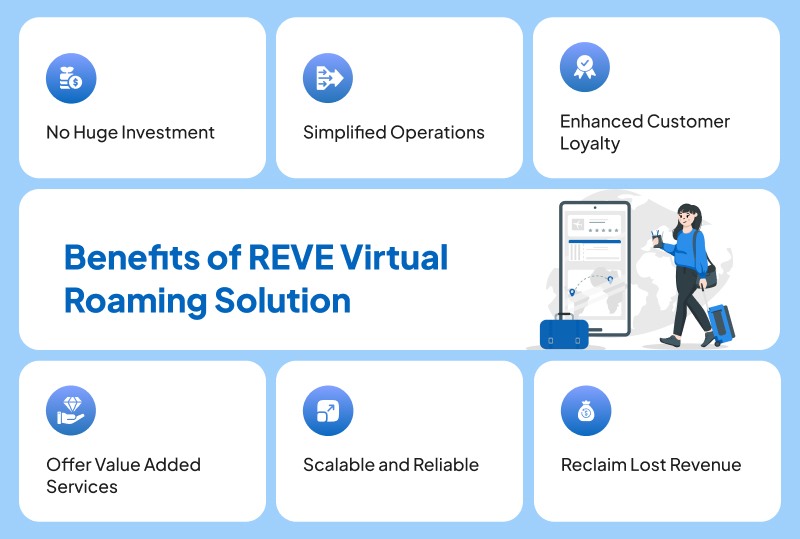
No Need to Invest in Roaming Infrastructure
Our app-based virtual roaming solution eliminates the hassle of building a roaming network from scratch, thus saving the time and resources of operators.
Simplified International Roaming Operations
REVE virtual roaming solution frees you up from the complex agreements and partnerships with foreign network operators. The process of offering international roaming services becomes simple and streamlined.
Enhanced Customer Loyalty
With our virtual roaming app, you can provide your customers with affordable and convenient roaming services, which certainly drives customer satisfaction and loyalty.
Retention of International Roaming Revenue
REVE virtual roaming solution enables operators to retain their revenue stream from international roaming services, even as they reduce costs for customers.
Offer Value-added Services to Customers
With our solution, operators can expand their service portfolio and improve competitive positioning. By introducing additional services like video calls, conference calls, and mobile money, operators can generate new revenue streams.
Scalable and Reliable Solution
REVE virtual roaming is a solution based on next-gen technology. The unmatched scalability and reliability effectively support your business’s growing subscriber base and adapt to the market needs.
Conclusion
So, from understanding what international roaming really is to exploring how it works behind the scenes, one thing is clear: roaming is far more than just “your phone working abroad.” It’s a complex system powered by multiple networks, technologies, and agreements, all working together to keep users connected wherever they go. And as we’ve seen, both users and telecom operators face their own set of challenges in making this experience smooth and reliable.
That’s why choosing the right roaming solution has become so important for telcos today. With evolving user expectations and growing global demand, relying on outdated systems just isn’t enough. Modern, virtualized roaming solutions not only simplify operations but also help reduce costs, improve control, and deliver a much better experience to end users.
Looking ahead, as global connectivity continues to grow, roaming will only become more seamless, intelligent, and user-friendly. And the operators who adapt early will be the ones leading this transformation. Get in touch with us for a free demo.
Frequently Asked Questions