What is Signaling System 7 (SS7)? A Definitive Guide
- August 27, 2026
- 15 Mins Read
- Listen
Language is the medium we use to communicate with each other in our daily lives. In the technological domain, protocols are the language used by devices to communicate and work with each other. SS7 is one such framework consisting of a family of protocols that has revolutionized how voice calls, SMS, and data services are delivered. With technology’s continuous evolution, SS7 now faces a complex interplay of innovation and security. This blog post explores this interesting topic in depth. Let’s get started!
What is Signaling System 7 (SS7)?
SS7 stands for Signaling System 7 and is also known as SS7 signaling, CCS7 (Common Channel Signaling No. 7), or C7. It is a global standard comprising a set of protocols used for telecommunications signaling for PSTN communication networks.
Let’s put it in simple words for you.
Primarily, SS7 protocols are used for PSTN telephone calls, i.e., set up and tear down. However, the usage of SS7 protocols expands to several other areas such as SMS, local number portability, etc.
Before SS7 came into existence, telecom networks relied on in-band signaling, i.e., control signals were sent over the same path as voice communication. This in-band signaling was easily vulnerable to fraud such as tone-based hijacking. SS7 made a transformative shift by introducing out-of-band signaling, which offered many benefits including:
- Improved call setup time and routing speed
- Increased security as signaling separated from voice channels
- Reduced congestion on voice paths.
Originally termed Common Channel Interoffice Signaling, the SS7 standard was introduced in 1970 and was deployed in circuit-switched networks like the PSTN. While many national variations of SS7 protocols adhere to ANSI and ETSI standards, the Chinese and Japanese TTC variants offer unique characteristics.
It was during the 1980s that the actual standardization took place, i.e., the International Telecommunication Union (ITU) formalized the SS7 protocol, and it became the global standard for signaling in telecom. Certainly, the interoperability of this protocol across different carriers and vendors was ensured.
Now that we have learned about how SS7 came into existence, let’s move ahead and learn more about some of the key components of the SS7 network.
How Does SS7 Work?
SS7 carries the signaling messages between telecom network elements so that they can decide how a call, SMS, or other service should be handled. Let’s understand its working with the help of an example.
Suppose a subscriber makes a phone call. The originating switch creates the required signaling information and sends SS7 messages through the signaling network. This signaling information is used by the network to identify the destination and route the call to the right switch.
When the terminating switch receives the signaling, the destination phone rings. Meanwhile, the SS7 continues to handle the call setup, ongoing control, and release when the call ends.
In case of an SMS, the process is quite similar. The network elements exchange signaling information about the subscriber’s location, destination, routing, delivery, and availability. For this exchange, MAP, i.e., Mobile Application Part, an SS7 application-layer protocol, is used.
Why was SS7 Developed?
One clear objective behind the development of SS7 was the limitations associated with older telecom signaling methods. In in-band signaling, control information was sent through the same channel used for voice, which made signaling less flexible and less efficient.
Of course, as telecom networks grew, operators needed more advanced ways for switches to communicate, set up calls faster, control services, and handle more than basic voice connections.
SS7 introduced CCS, i.e., Common Channel Signaling. This enabled signaling information to travel through a separate signaling network instead of using the voice channel. As a result, control information was exchanged between networks more quickly and efficiently.
Moreover, services like call forwarding, caller ID, SMS, and roaming were supported. Overall, SS7 made it easier for different network switches and international telecom networks to work together.
SS7 Network Architecture and Components
There are typically 3 types of signaling points around which SS7 networks are built. These points work together to handle call signaling, message routing, and access to service information. Let’s understand each of these points:
Service Switching Point (SSP)
SSP generates and receives SS7 signaling messages. It is responsible for starting the signaling needed to set up or end a call. In essence, SSP connects subscribers to the network services they’re trying to use.
Signal Transfer Point (STP)
It works like a router for SS7 signaling. An STP focuses on moving signaling between network elements, i.e., it receives signaling messages and forwards them to the right destination based on point codes and other routing information.
Service Control Point (SCP)
An SCP is responsible for providing access to service logic and subscriber or service databases. It’s commonly used with intelligent network services, allowing switches to request information they need to complete a particular service.
What are SS7 Signaling Links?
SS7 signaling points are the points of interconnection between different network elements. They can be classified into two main types:
- Point Codes: These are unique codes assigned to network elements, such as switches and routers.
- Service Codes: These are codes that identify specific services, such as voice, SMS, and data.
What are SS7 Signaling Modes?
Signaling modes are the paths taken by signaling messages between network nodes. SS7 networks mainly prefer 2 types of signaling modes, i.e., Associated Mode and Quasi-Associated Mode. However, there’s another mode called the Non-associated signaling mode, which is sometimes used but not preferred. Let’s understand these signaling modes in more detail one by one:
Associated Mode
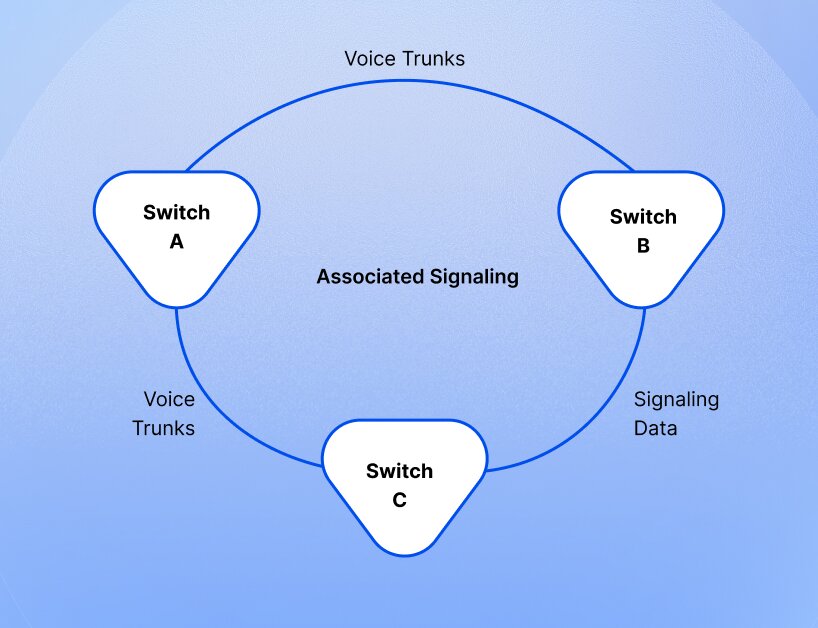
In this type of signaling mode, signaling messages are associated with a specific call and are transmitted on the same channel as the voice or data traffic. This mode is ideal for simple and small setups without complex routing needs.
Non-Associated Signaling
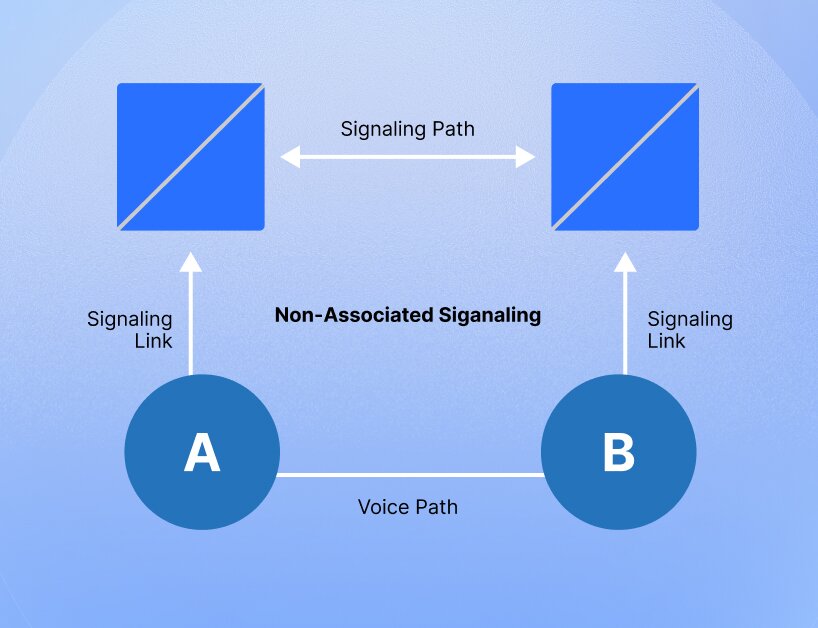
In non-associated signaling, the signaling messages do not travel over the same channel or path as the user data, but instead, they are routed through an entirely separate signaling network. This mode is ideal for large, complex networks and improves network resilience as messages are routed dynamically
-
Quasi-Associated Mode
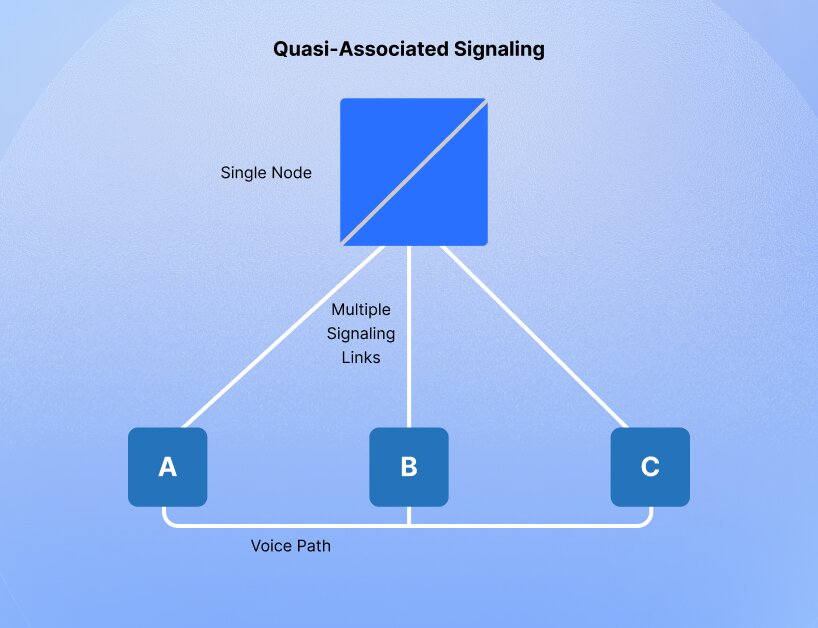
Quasi-Associated Signaling is a hybrid mode where signaling messages take an indirect path via one or more intermediate STPs, but these paths are pre-determined. Once the messages reach a final STP, they are delivered directly to the destination node.
What are SS7 Switches?
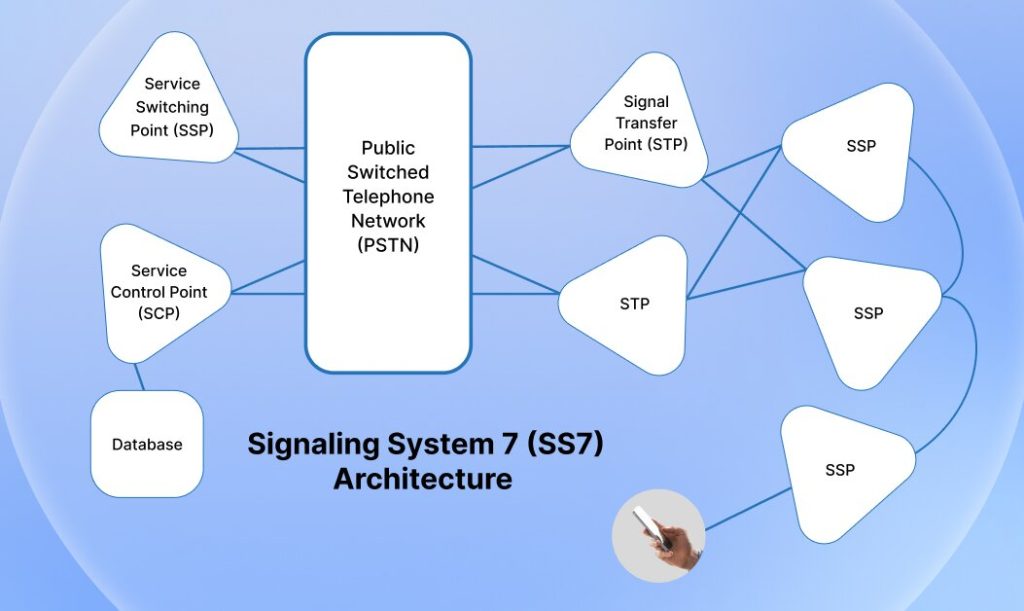
SS7 switches are an important backbone component of the SS7 network. These specialized networking devices are responsible for routing and managing signaling traffic. The very purpose of SS7 switches is to manage the communication between network elements in a PSTN or cellular network. These switches mainly interconnect with SS7-capable devices like HLR, VLR, and SCP, or other telephone network switches, and are not used to connect a local exchange to a customer.
There are many functions that SS7 handles, including:
- Call setup and tear down
- Call routing
- Advanced calling features
- Short Message Service (SMS) transmission
- Database queries
Components of SS7 Switches
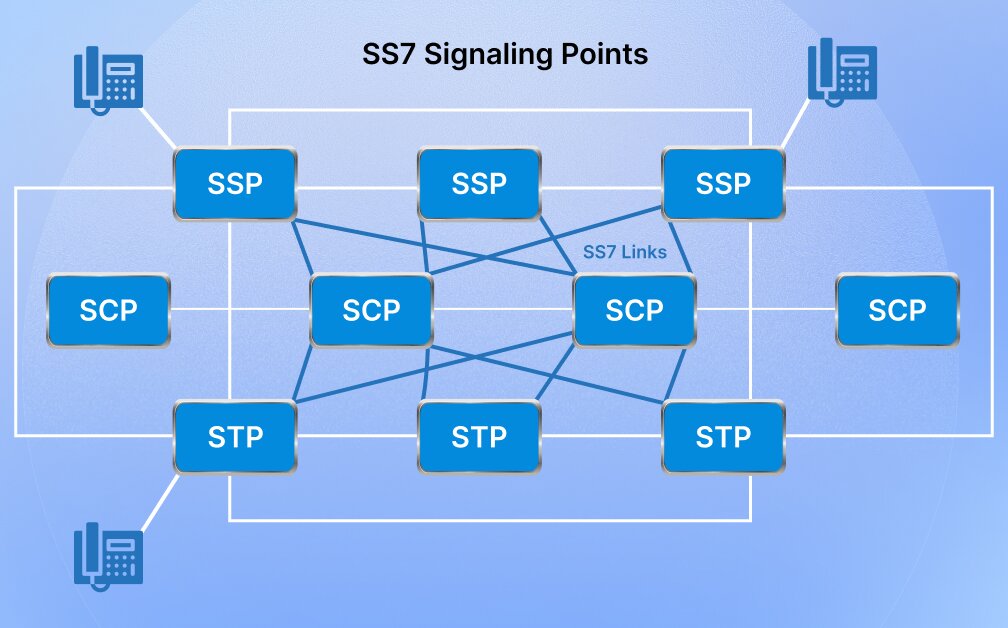
SS7 switches consist of specialized nodes in an SS7 network, including:
- Signal Transfer Point (STP)
A crucial component of the SS7 network, STP is responsible for routing signaling messages between different elements within the network and ensuring that messages are directed to the correct destination.
- Service Switching Point (SSP)
SSPs are responsible for initiating and terminating signaling communication for setting up calls or services.
- Service Control Point (SCP)
SCPs interface with databases like HLR or VLR to provide advanced services (e.g., toll-free call routing or prepaid billing).
SS7 Protocol Stack Explained
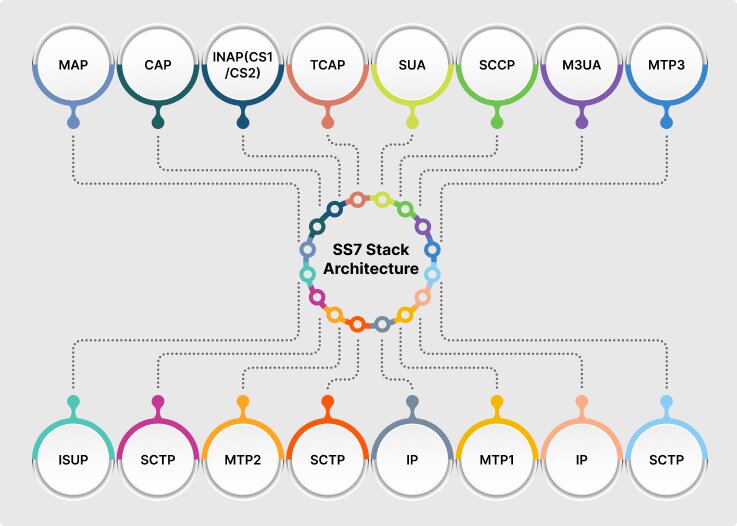
SS7 consists of a layered protocol stack. In this stack, each protocol handles a different part of the signaling process. While it’s quite vast, we’ll have a quick look at the ones that you’ll come across most often: MTP, SCCP, TCAP, MAP, and ISUP
MTP (Message Transfer Part)
It handles the transfer and routing of SS7 signaling messages between signaling points. It looks after message delivery, link management, and routing across the signaling network.
SCCP (Signaling Connection Control Part)
It adds more advanced addressing and signaling capabilities. It is with its help that messages get routed to specific applications or network elements using information such as point codes.
TCAP (Transaction Capabilities Application Part)
It supports transactions between applications and network databases. It’s typically used when one network element needs to request information from another and receive a response.
MAP (Mobile Application Part)
It’s the go-to protocol in mobile networks for services such as SMS, roaming, subscriber authentication, and location management.
These protocols work like a chain. First, the MTP moves the signaling, then SCCP helps address and route that signaling; after that, TCAP handles the transaction, and at last, protocols such as MAP or ISUP deal with the actual telecom service.
How Does SS7 Work for SMS?
Here, we will discuss the working of SS7, particularly for SMS delivery, to understand how SS7 plays a crucial role in the delivery of SMS messages:
- Message Creation
When you compose an SMS message on your phone, it’s converted into a specific format.
- Sending to the Mobile Network
Your phone sends the SMS to the nearest mobile network tower.
- SS7 Network Involvement
The mobile network then uses the SS7 network to route the SMS to the recipient’s network.
- Message Routing
The SS7 network, consisting of various switches and routers, determines the optimal path for the SMS. It may pass through multiple networks and countries before reaching the destination network.
- Delivery to the Recipient’s Phone
The SMS is finally delivered to the recipient’s mobile phone, which decodes and displays the message.
Several key components of SS7 contribute to the entire process of successful delivery of SMS messages. Let’s take a look:
| Component | Function |
| Home Location Register (HLR) |
Stores information about subscribers, including their current location & service provider.
|
| Visitor Location Register (VLR) |
Tracks the location of roaming subscribers.
|
| Message Center |
Stores and forwards SMS messages.
|
| Short Message Service Center (SMSC) |
Handles the routing and delivery of SMS messages.
|
SS7 Security: Vulnerabilities and Protection
Modern-day networks are in constant risk of various threats such as subscriber location tracking, SMS interception, signaling fraud, and unauthorized access to signaling networks.
Telecom operators need to protect subscriber privacy, communication security, and network operations using various security mechanisms. These include SS7 firewalls, signaling filtering, access controls, continuous monitoring, and anomaly detection.
With the help of these measures, operators can identify suspicious signaling activity, block unwanted messages, control which networks and systems can access signaling services, and flag unusual traffic before it causes damage. The point is to allow only authorized traffic to pass while keeping the illegitimate traffic out.
What is SIGTRAN and Why was it Introduced?
With the expansion of mobile networks in the 1990s, SS7 further solidified its role as a critical protocol. When in 2000s the internet and VoIP technology ushered in, traditional circuit-switched networks began transitioning to packet-switched systems. During this time, though SS7 remained dominant, it faced challenges in terms of security, scalability, and adaptability to IP-based networks.
SIGTRAN stands for Signaling Transport protocol. Primarily, this protocol was developed to address the limitations of SS7, enabling it to operate over IP networks. In other words, SIGTRAN emerged as a solution to integrate SS7 signaling with the modern IP infrastructure, while addressing its scalability and security shortcomings.
This transition brings several advantages for telecom signaling, including:
- Better Scalability and Flexibility
IP-based networks can handle a much larger volume of signaling traffic. SIGTRAN leverages the inherent scalability and flexibility, thus allowing for easier network expansion and adaptation to changing traffic patterns.
- Cost Efficiency
SIGTRAN utilizes existing IP infrastructure, thus reducing the dependency on costly SS7-specific hardware and leased lines. This helps in reducing CAPEX, i.e., capital expenditure associated with dedicated signaling networks. Furthermore, IP networks make efficient use of resources, which lowers the operational costs, i.e., OPEX.
- Enhanced Security
SS7 lacks encryption; however, SIGTRAN can employ advanced security mechanisms such as encryption and authentication. Additionally, SIGTRAN allows the use of secure IP protocols such as IPsec and TLS. Altogether, this helps protect against eavesdropping, message tampering, and other threats.
Key Protocols in SIGTRAN
The SIGTRAN family of protocols includes several names, of which we are going to discuss the main 3 protocols, as mentioned below:
- Stream Control Transmission Protocol (SCTP)
The SCTP protocol offers features like multi-streaming and multi-homing for reliable, ordered, and flow-controlled transport of signaling messages.
- M3UA (Message Transfer Part 3 User Adaptation)
It maps SS7 messages onto SCTP / Adapts SS7’s MTP Level 3 for IP networks, enabling seamless communication between SS7 and IP domains.
- SUA (Signaling Connection Control Part User Adaptation Layer)
It enables SCCP user messages and service interfaces to traverse IP networks via an SCTP adaptation layer.
Overall, while SS7 and SIGTRAN serve the same purpose for SMS delivery, SIGTRAN modernizes the process by leveraging IP networks, offering greater efficiency and scalability. Let’s move ahead to discuss how SS7 and SIGTRAN coexist in modern networks.
SS7 vs SIGTRAN: What’s the Difference?
The very first thing to understand is that SS7 and SIGTRAN are not direct alternatives, because they play different roles in telecom signaling.
Here’s a glance at what they do:
| Technology | What it does | Common use |
| SS7 | Exchanges signaling information between telecom network elements |
PSTN, mobile networks, SMS, roaming
|
| SIGTRAN | Carries SS7 signaling over IP networks |
SS7-to-IP migration, signaling gateways, telecom interconnects
|
With the above table, it is clear that SIGTRAN isn’t a replacement for SS7 in terms of signaling functions. It provides a way to transport SS7 messages over IP, while SIP is a separate signaling protocol designed for IP communication sessions.
SS7 and SIGTRAN Interworking in SMS Delivery
Today, many telecommunications networks employ a hybrid approach, i.e., combining SS7 and SIGTRAN. This interworking brings together complex protocols and mechanisms to ensure a smooth transition to IP-based signaling. In hybrid networks, SS7 is used for legacy systems like 2G and 3G networks. In 4G/LTE and IP-based systems, SIGTRAN bridges SS7 with these networks.
Our platform, REVE SMS, is designed to support both SS7 and SIGTRAN, providing robust and scalable solutions for SMS delivery in various network environments.
Let’s move further to understand how our SMS platform effectively makes use of the SS7 & SIGTRAN framework for successful SMS delivery.
How REVE SMS Uses SS7 and SIGTRAN for SMS Delivery
A network has to perform several functions to send a message from one point to another. REVE SMS supports both SS7 and SIGTRAN, making the job easier for traditional telecom networks as well as IP-based infrastructure.
How REVE SMS Leverages SS7 for SMS Delivery
SS7 remains a cornerstone in traditional telecom networks like GSM and PSTN, making it an essential component for SMS delivery in legacy systems. REVE SMS harnesses SS7 to enable seamless message delivery through:
- Direct Connectivity with Legacy Networks
REVE SMS utilizes SS7 to connect directly with Mobile Network Operators (MNOs) and key elements like SMSC (Short Message Service Centers). This ensures fast and reliable message transmission across global networks.
- Real-Time Routing and Signaling
With SS7, our platform ensures efficient message routing by communicating with databases such as HLR (Home Location Register) to verify subscriber information and determine the correct destination for SMS.
- Support for Advanced Features
Beyond basic SMS delivery, REVE SMS supports advanced SS7 features like delivery receipts (DLRs) and message prioritization, critical for time-sensitive communication in industries like banking or healthcare.
Besides SS7, REVE SMS platform also supports SIGTRAN for SMS delivery, which is explained in the next section.
How does REVE SMS Optimize SMS Delivery with SIGTRAN?
As networks evolve towards IP-based infrastructures, SIGTRAN plays a pivotal role in modernizing SMS delivery. REVE SMS supports SIGTRAN to bring the benefits of IP transport to telecom signaling, offering:
- High Scalability for Growing Traffic
SIGTRAN allows REVE SMS to handle large volumes of SMS traffic efficiently, leveraging packet-switched networks for cost-effective and scalable delivery. This is especially critical for businesses managing high message volumes, such as e-commerce promotions or bulk messaging campaigns.
- Seamless Integration in Hybrid Networks
In networks transitioning from traditional SS7 to IP-based systems, SIGTRAN enables REVE SMS to operate as a bridge, ensuring compatibility with both legacy and modern infrastructures.
- Enhanced Reliability and Performance
Using SCTP, SIGTRAN minimizes latency and packet loss, ensuring faster and more reliable SMS delivery even during network congestion.
Why Supporting Both Protocols Matters?
The diversity in the global telecom network infrastructures is the primary reason for supporting both SS7 and SIGTRAN protocols. While each protocol caters to specific technological environments, having dual support ensures comprehensive compatibility.
- Supporting Legacy Networks
SS7 is deeply integrated into PSTN networks and dominant in regions with established legacy systems. By supporting SS7, REVE SMS ensures compatibility with these networks, without requiring infrastructure upgrades. This is extremely beneficial for operators that prioritize cost-effective and reliable services using their existing infrastructure.
- Supporting Modern IP-Based Networks
In recent times, telecom operators have rapidly shifted towards modern IP-based networks, owing to these networks’ flexibility, scalability, and cost-efficiency. By supporting SIGTRAN, REVE enables operators to leverage the benefits of these modern networks.
- Hybrid Networks
Many telecom operators operate hybrid networks, where SS7 and SIGTRAN coexist. Such scenarios are common when transitions happen from legacy to IP-based infrastructures. By supporting both SS7 and SIGTRAN, REVE SMS ensures that messages can seamlessly traverse the mixed environments, thus providing a unified solution that adapts to any infrastructure.
This versatility ensures that REVE SMS can meet the needs of global businesses, regardless of the telecom infrastructure in place.
Conclusion
The combination of SS7 and SIGTRAN has revolutionized SMS delivery, supporting billions of messages sent daily with unmatched reliability and global reach. While SS7 laid the foundation with its robust signaling capabilities, SIGTRAN has modernized the process by integrating IP-based networks, offering scalability, speed, and cost-efficiency.
With over 5.5 billion mobile phone users worldwide relying on SMS for personal and business communication, the role of SS7 and SIGTRAN remains critical. As telecommunications evolve with technologies like 5G, these protocols will continue to adapt, ensuring the seamless delivery of SMS in an increasingly connected world.
Frequently Asked Questions