Generative AI in Telecom: How it is Transforming the Telecom Industry
- May 30, 2026
- 12 Mins Read
- Listen

Telecom has always been a complex and dynamic industry – complicated networks, changing customer expectations, growing data, and the need to deliver instant support across all channels. Managing modern communication infrastructure has never been easier. This is why the adoption of Generative AI in telecom is quickly increasing. Earlier, the role of AI in telecommunication was all about analytics, automation, fraud detection, and basic chatbot workflow. But that trend is now shifting towards something bigger.
From supporting agents in real time, to predicting service disruptions and analyzing customer behavior, and automating tasks that required huge operational teams, AI has started helping telecom operators immensely in several different ways.
This post is our take on how Generative AI is changing telecom operations. We will explore real-world use cases, how operators are using AI in different ways, along with the challenges that telcos still need to figure out.
What is Generative AI?
Generative Artificial Intelligence or Generative AI, is are the systems that can create new content, responses, recommendations, summaries, and even conversational outputs from existing data. Unlike traditional AI systems, which mostly focus on analyzing patterns, processing information, or predicting outcomes. Generative AI has actually brought a big shift as it can produce new outputs based on what it has learned.
According to Research and Markets, the Generative artificial intelligence (AI) in telecom will grow to $1.12 billion in 2026 and is expected to reach $6.16 billion in 2030 at a CAGR of 53%.
Traditional AI vs Generative AI
Traditional AI has already been a part and parcel of the telecom industry for years now. These systems were great at identifying patterns and making decisions based on data. Some common areas where telcos have been using traditional AI include:
- Fraud detection
- Traffic forecasting
- Predictive maintenance
- Spam filtering
- Customer behavior analysis
But Generative AI has much more capability and works differently. Not only can it analyze information, but it can also generate:
- Human-like responses
- Customer support conversations
- Technical summaries
- Knowledge base articles
- Workflow suggestions
- Personalized recommendations
How Generative AI Actually Works
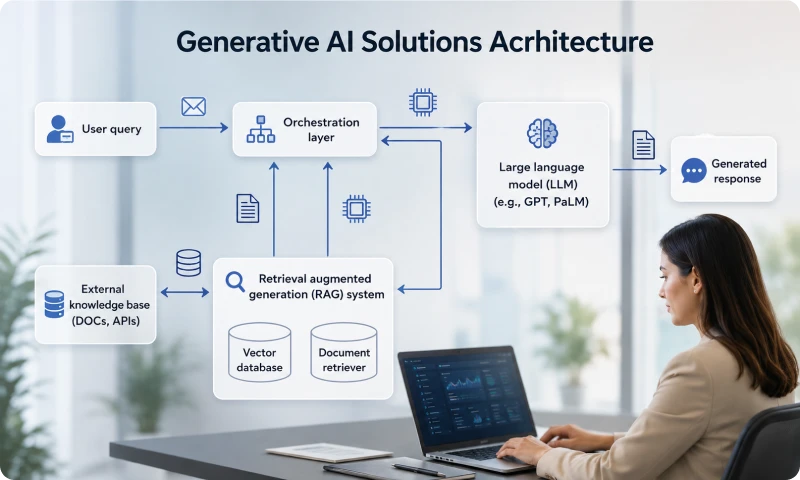
We have just learned about what Generative AI does; now, let’s delve into the technical aspects. Generative AI relies on several technologies working together. Here are some of the major ones:
Large Language Models (LLMs)
Large Language Models, or LLMs, are artificial intelligence systems that are trained using vast amounts of text and data. With this, LLMs can understand patterns in language, context, and communication. From generating responses, answering questions, summarizing information, creating conversational interactions, to understanding intent, LLMs do a lot of things. The simplest example of LLMs at work is when people interact with AI chat systems naturally.
Natural Language Processing (NLP)
NLP is another type of artificial intelligence system that understands human language, not just words, but also the meaning, tone, intent, and context. So basically, it bridges the gap between human communication and computer comprehension.
Machine Learning (ML)
Another subset of Artificial Intelligence that helps AI systems improve by learning from data and ongoing interactions. In telecom, ML models learn from customer interactions, network behavior, billing trends, support ticket and various other things.
Conversational AI
This branch of AI specifically focuses on interactive communication between humans and AI systems. It performs the job of making interactions feel more natural.
Why Telecom Companies Are Investing in Generative AI
Telcos never chase trends; they only invest in something when it’s truly worthwhile. The growing investment in Generative AI itself is proof that this technology can help telcos handle multiple problems effectively.
AI has become a top priority in telecom. According to industry research, 97% of telecom executives are either evaluating or implementing AI to improve customer experience, optimize network operations, and lower operational costs.
Rising Customer Expectations

Like every other industry, customers in the telecom industry expect faster responses, personalized communication, 24/7 availability, and a consistent experience across multiple channels. Traditional telecom support systems struggle to meet these expectations, especially at scale.
Generative AI solves this problem by enabling telecom providers to respond faster through:
- AI-powered chat support
- Automated troubleshooting
- Real-time response suggestions
- Smart self-service systems
Interestingly, research shows that 83% of consumers view chatbot interactions positively, while 51% would rather use a chatbot than wait for a human agent when seeking immediate support.
Increasing Operational Complexity
Telecom infrastructure is a complex system where operators need to manage mobile networks, broadband systems, voice services, billing systems, roaming environments, subscriber management platforms, cloud infrastructure, and 5G deployments. Manually managing these massive systems and the huge amount of data they generate is almost impossible.
Generative AI simplifies this job by analyzing large volumes of information and generating useful operational insights automatically.
Growing Support Volumes
People rely on telecom services for many important things that run their daily lives. Be it work, streaming, payments, messaging, video calls, smart devices, business operations, or remote services – connectivity plays a key role everywhere. But even if a small service disruption happens, support requests spike immediately.
Manual handling of such requests is simply too much. Generative AI helps telcos by
- Automating common responses
- Summarizing conversations
- Assisting agents during calls
- Routing customer requests intelligently
- Reducing average handling time
Demand for Personalized Services
Modern-day customers expect telcos to understand their preferences and provide them with personalized plan recommendations, relevant promotions, location-aware services, etc. About 60% of consumers believe companies should use customer data to make interactions and services more relevant to their needs. Generative AI does this job quite efficiently, helping telcos to deliver experiences that sound less generic and more personalized.
Need for Faster Network Issue Resolution
Network issues can affect a business’s customer experience, its reputation, and revenue. The time telcos take to identify and resolve network problems should be as little as possible. In traditional ways, network operations teams do the job of analyzing issues and identifying root causes. But that consumes a lot of time. Generative AI speeds up that process quite significantly.
Generative AI systems can:
- Detect unusual traffic behavior
- Predict potential failures
- Generate incident summaries
- Recommend troubleshooting actions
- Prioritize critical outages
Organizations using AI for predictive maintenance often see unplanned downtime drop by 30% to 50%. In more advanced implementations, outage durations have been reduced by as much as 70% to 85%. (Source)
Pressure to Reduce Operational Costs
It won’t be wrong if we say that operational costs in telecom are enormous. Infrastructure maintenance, customer support operations, network management, service monitoring, and data processing – expenses are endless.
Generative AI automates repetitive tasks and improves workflow efficiency by automating:
- Generate support summaries
- Handle routine customer interactions
- Create technical documentation
- Assist internal teams
- Analyze operational reports
When repetitive operational work is automated, teams are better able to focus on complex problems.
Fraud Detection and Security Are Becoming Smarter

Among all the challenges that telecom companies face, fraud is one of the biggest operational challenges. Industry estimates suggest that telecom fraud results in annual losses of $41.82 billion, nearly a $3 billion increase from 2023. These frauds arrive in the form of:
- SIM swap fraud
- Robocall abuse
- Artificial traffic generation
- International revenue share fraud
- Account takeover attempts
Now, with the scale at which telcos operate, manual monitoring of such threats becomes simply impossible. AI systems are smart enough to identify fraud patterns, flag the behavior immediately, and trigger preventive actions. This is of significant value for telcos as fraud losses can grow quickly if abnormal activity goes unnoticed.
Real-World Generative AI Use Cases in Telecom

Now let’s get to the most interesting part – how operators are actually using Generative AI in production environments. Here are some real examples from major telcos:
Vodafone: AI-Powered Customer Support and Network Operations
Vodafone, one of the world’s largest telecommunications companies, has been actively investing in AI-driven customer experience and operational automation initiatives. Their primary focus has been on AI-powered customer support, utilizing conversational AI to handle billing inquiries, troubleshoot requests, manage accounts, and address service-related questions. This implementation helps them reduce the dependency on human agents. Furthermore, the telecom giant has also explored AI for network optimization and predictive maintenance.
AT&T: AI for Network Management and Customer Experience
AT&T is another renowned name in the telecom industry. This telco has also invested heavily in AI and ML across network operations and customer support systems. AT&T has implemented AI-driven analytics for network monitoring, service disruption prediction, and boosting operational efficiency. The company has also explored Generative AI and conversational AI technologies to assist agents and automate various parts of the customer service experience.
Verizon: AI-Driven Customer Personalization
Another key player in the telecom industry, Verizon, has focused significantly on AI-powered customer engagement and personalization strategies. This means the telco has used AI systems for understanding customer preferences in better ways to deliver personalized offers, improve recommendations, and optimize marketing communication. Besides this, Verizon has also explored AI-driven operational analytics.
Orange: AI-Powered Digital Customer Interactions
Orange is another key player that has invested in Generative AI. The company has explored conversational AI solutions for digital customer engagement. Moreover, this telco has also explored AI applications for cybersecurity and fraud prevention.
Telefonica: AI for Predictive Operations and Smart Automation
Telefonica has been exploring AI and automation for years. The company is using AI technologies across various domains, including network optimization, predictive maintenance, customer analytics, and operational automation.
Challenges of Using Generative AI in Telecom
Looking at all the possibilities that Generative AI offers, it sounds really exciting, doesn’t it? Telcos get faster support, smarter automation, better network visibility, and even lower operational workload. However, when it comes to the practical deployment of AI inside telecom environments, things are not that simple.
Telecom infrastructure is highly sensitive, regulated, and interconnected. Even one wrong automation decision can affect thousands or sometimes millions of users in a short span of time. So telecom operators are being very careful about when, where, and how AI systems are deployed. Let’s understand:
Data Privacy and Security Risks
Telcos handle massive amounts of sensitive customer information every single day in the form of call records, billing information, location-related data, payment details, and a lot more. Now, when it is about involving Generative AI systems that require access to large datasets for their work, certain privacy and security concerns arise. Simply exposing customer information inside AI environments can put telcos at huge risk.
However, this problem can be mitigated by ensuring that AI deployments have
- Strong encryption
- Access controls
- Data governance policies
- Authentication mechanisms
- Audit tracking
Integration With Legacy Telecom Systems
Several telecom operators still rely on legacy infrastructure, such as older billing systems and traditional switching platforms. These environments do not have the flexibility to integrate modern AI systems, including Generative AI.
Dependency on Data Quality
Generative AI works on data that is fed to it. In telecom, data is often stored on different systems with inconsistencies. For the best outputs from Generative AI, it needs:
- Accurate data
- Consistent formatting
- Real-time synchronization
- Clean operational records
Telcos may need to implement data optimization strategies to ensure accurate and high-quality outputs from their Generative AI systems.
Resistance From Employees and Operational Teams
Often overlooked, AI adoption doesn’t often happen as smoothly as expected. Telecom employees often worry that AI automation may eventually reduce jobs, and hence, they are resistant to adopting this technology. To tackle this situation, telcos need to focus on these:
The core idea here is to make employees understand that AI is to be used as a support tool rather than a human replacement strategy.
Future Trends of Generative AI in Telecom
Though Generative AI has already entered the telecom industry, several operators have made mature deployments in customer support and automation workflows, while many others are actively experimenting. With this, one thing is certain: AI will penetrate deeply into telecom operations over the next few years.
Let’s see the possibilities:
AI-Driven Autonomous Networks
The shift towards self-optimizing is on a continuous rise. This means telecom operators are highly likely to use AI for automatically detecting network congestion, rerouting traffic, and managing performance with minimal human effort.
Hyper-Personalized Customer Experiences
Generative AI is also highly likely to take personalization to the next level by providing highly customized offers, recommendations, and support interactions based on real-time customer behavior.
AI Copilots for Telecom Employees
The use of AI copilots will increase to assist telecom agents, engineers, and operational teams through automated summaries, recommendations, and troubleshooting guidance during real-time interactions.
Smarter AI Fraud Detection
Generative AI is certainly going to make improvements in telecom fraud prevention by analyzing behavior patterns and identifying suspicious activities in a much faster way.
With communication networks becoming too large, too dynamic, and too interconnected, the industry surely needs a larger operational shift, and Generative AI is probably the best way possible.
Key Takeaway!
What began as chatbots and automation is now spreading into network optimization, predictive maintenance, fraud detection, customer engagement, operational reporting, and many other things. With telecom networks growing and customer expectations rising continously, the importance of adopting AI technologies becomes more significant. With time, as this technology becomes more mature, the future telecom networks are likely to be defined by not just faster connectivity but by intelligent, AI-driven operations working seamlessly behind the scenes.
At REVE, we have 20+ years of experience in delivering carrier-grade communication platforms for telecom operators and communication service providers worldwide. We understand both the opportunities and challenges of adopting Generative AI in telecom. So whether you are exploring AI-powered customer engagement, intelligent automation, or next-generation telecom platforms, our experts can help you with practical, scalable solutions. Get in touch with us!
Frequently Asked Questions