On-Premise vs Cloud Contact Center: Which One is Better for Your Business?
- June 5, 2026
- 18 Mins Read
- Listen

Those in the contact center industry probably have heard this argument more times than they can count: cloud is the future, on-premise is outdated. However, making that shift in real life is not as straightforward as it may sound. In the on-premise vs cloud contact center conversation, one thing is clear: neither of them is universally better. The ideal choice of solution depends upon how your business operates, what resources are available to you, and the direction of your customer service strategy over the next few years.
In this post, we will break down the key differences between cloud and traditional contact center models and explain how each model works. We’ll also explore advantages, challenges, and several other important metrics. Our objective here is to help you determine which option aligns best with your business’s goals.
What is a Contact Center?
The term ‘contact center’ is quite commonly interchanged with the term ‘call center’. While these two are related, they aren’t the same thing. Let’s learn.
In contact center operations, the customer interactions are managed across multiple communication channels. This means a contact center software acts as a centralized platform through which businesses can engage with customers through voice, email, live chat, SMS, social media, messaging apps, video, and other digital channels.
A call center, on the other hand, handles customer communication over phone calls only. While it serves a primary function of the customer support operations, this often lacks the flexibility that a contact center offers.
The goal of the contact center approach is to move beyond voice-only support and provide customers with the convenience of choosing their preferred communication channel when they want to reach out to a business.
Modern contact centers support a wide range of communication channels, including:
- Voice calls
- Live chat
- SMS and text messaging
- Social media messaging
- Messaging apps (WhatsApp & Messenger)
- Video support sessions
- Customer self-service portals
- AI-powered chatbots and virtual assistants
Suppose a customer contacts a business initially through live chat, then sends an email asking for details about their purchase, and later calls support for immediate technical assistance. A contact center helps them do all of this with ease, creating a more connected experience.
What is an On-Premise Contact Center?
An on-premise contact center refers to the traditional contact center model, which is hosted and managed within a company’s or an organization’s own infrastructure. This means the company owns the hardware, installs the software, manages the servers, performs network maintenance, and is responsible for ongoing operations.
In simple words, all the critical components of the contact center are deployed inside the company’s physical premises.
For decades, this approach for contact center operators worked well until the cloud started becoming popular. Though cloud adoption has grown significantly, the on-premise contact centers are still being used in industries where control, security, compliance, and infrastructure ownership are major priorities.
How an On-Premise Contact Center Works
Within an on-premise deployment, the whole contact center environment is located inside the premises. Typical components include:
- Contact center software
- PBX or IP-PBX systems
- Application servers
- Database servers
- Telephony infrastructure
- Storage systems
- Network equipment
- Security systems and firewalls
All these components and communication stay under the company’s direct control.
What is a Cloud Contact Center?
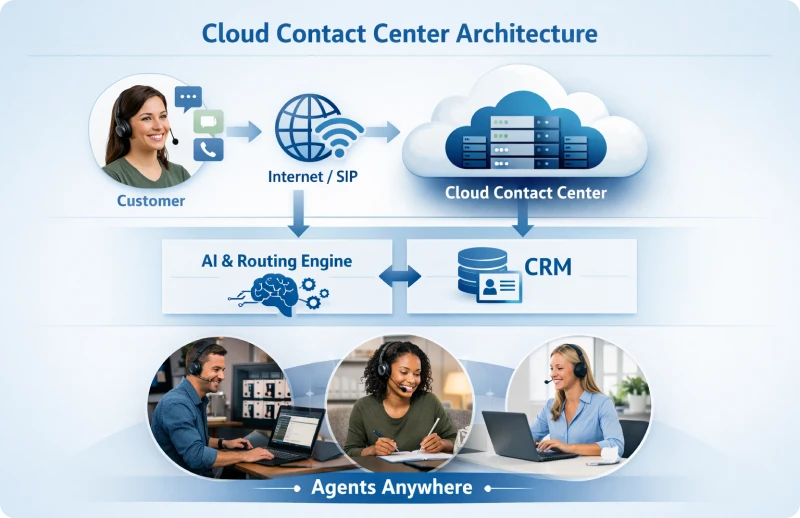
The cloud contact center model works on a different approach. Rather than hosting the entire system internally, it enables businesses to access all the contact center’s capabilities through a service provider’s infrastructure. This means the provider manages the technology and the customers, i.e., companies subscribe to their service and use the platform through an internet connection.
This is the reason why cloud contact centers are also termed as Contact Center as a Service or CCaaS. It is because of the flexibility, scalability, and fast deployment of cloud contact centers that these have become one of the fastest-growing segments of customer experience technology. The global cloud-based contact center market is forecast to expand significantly, reaching USD 116.33 billion by 2031 with a strong CAGR of 23.6% during the 2026–2031 period.
How a Cloud Contact Center Works
In a cloud setup, the service provider handles everything, including
- Infrastructure management
- Server maintenance
- Software updates
- Security patches
- System monitoring
- Backup management
- Platform availability
Agents connect with the platform through web browsers, desktop applications, or mobile devices. So when customers reach out, the communication is processed through the service provider’s cloud infrastructure and delivered to the appropriate agents.
Comparison: On-premise vs Cloud Contact Center
| Feature | On-Premise Contact Center | Cloud Contact Center (CCaaS) |
| Deployment & Setup | Requires physical servers, hardware, and infrastructure installed on-site. Deployment can take months. | Hosted over the internet by a third-party provider. Deployment is rapid (days or weeks). |
| Upfront Cost (CapEx) | Requires significant initial investment in hardware, licenses, server rooms, and architecture. | Minimal upfront costs; no hardware to purchase. |
| Ongoing Cost (OpEx) | Predictable but high maintenance costs (IT staff, hardware upgrades, power, and real estate). | Pay-as-you-go model (per-user/per-month), which scales with usage. |
| Scalability & Flexibility | Scaling up or down requires buying more hardware/licenses and manual configuration. | Easily add or remove agent licenses and features instantly through a dashboard. |
| Maintenance & Upgrades | Managed entirely by your internal IT team. Upgrades can cause downtime and require manual testing. | Managed by the vendor. Upgrades, patches, and new features are pushed automatically with zero downtime. |
| Reliability & Uptime | High control, but vulnerable to local power outages, hardware failures, or natural disasters. | High uptime guarantees (often 99.99%+), backed by redundant, geographically distributed data centers. |
| Security & Compliance | Full control over data storage and security protocols. Ideal for highly strict, legacy compliance needs. | Strong security, but relies on the vendor’s certifications (GDPR, HIPAA, PCI-DSS). |
| Remote Work Support | Complex to set up. Requires VPNs, specialized software, and robust home internet bandwidth. | Native support for remote work. Agents only need a computer, a headset, and an internet connection. |
| Integrations | Custom integrations are possible but usually complex, expensive, and require specialized development. | Built-in APIs and pre-built integrations with CRMs and business tools. |
On-Premise vs Cloud Contact Center: Key Differences
When we compare on-premise and cloud contact centers at a high level, we can say that both do the same job. They help companies manage customer communication in an organized and effective way. The real difference between the models is in how they’re built, managed, and scaled.
Let’s break it down.
Deployment and Infrastructure
This is the most obvious difference. In an on-premise setup, the system runs on infrastructure owned and managed by the company itself. Everything, including servers, networking equipment, storage systems, telephony hardware, and software live inside the physical premises of the company.
Cloud contact centers take a different approach. The infrastructure is hosted by the service provider in their data centers. Companies can access the cloud contact center platform through the internet and use it as a service, without having to manage the infrastructure.
Initial Investment and Cost Structure
This matters a great deal to most companies. With on-premise setups, there’s typically a huge upfront investment. A business opting for an on-premise contact center needs to purchase:
- Servers
- Telephony equipment
- Contact center software licenses
- Storage systems
- Networking infrastructure
- Security solutions
This model follows the CapEx approach, i.e., most of the expense happens before the system even goes live.
On the other hand, cloud contact centers usually work on an OpEx model, i.e., the business needs to pay a recurring subscription rather than buy infrastructure. Here, the upfront cost is low.
It is important to note here that in the cloud model, the subscription fee is based on several factors, including the number of agents, the features used, the usage levels, and service plans.
Maintenance and Upgrades
This is something which is often underestimated. Besides upfront investment, on-premise contact center setups also need resources for:
- Install updates
- Monitor performance
- Replace aging hardware
- Apply security patches
- Handle backups
- Resolve infrastructure issues
Contrarily, cloud contact center platforms remove much of that burden because the infrastructure is handled by the service provider. So whether it is a feature update, server maintenance, or software update, everything is done by the provider.
Scalability
This is where cloud platforms absolutely shine. Imagine your business hires 50 new agents. Now, if you have an on-premise setup, scaling may involve several things, like:
- Purchasing additional hardware
- Expanding storage capacity
- Buying more licenses
- Configuring new infrastructure
All of this takes time – sometimes a few weeks or even months.
With cloud environments, flexibility always comes instantly and easily. Whether a business needs to scale temporarily or permanently, cloud platforms make it easy because the business doesn’t need to invest in infrastructure; they just need to add or remove users as needed.
Accessibility and Remote Work Support
Remote work was never a big conversation until now. Traditionally, contact centers were run within on-premise environments using company-managed equipment connected to internal systems. Remote access was possible, but it was complicated as it required VPNs, some configurations, and extra security measures.
Cloud contact center platforms are designed keeping in mind the modern-day distributed workforces. No matter where agents are located, they can log in to the platform as long as they have stable internet access. This flexibility is especially valuable for businesses that want to operate across the globe without establishing physical offices.
Security and Compliance
There is no direct answer to the question of whether on-premises is more secure than cloud platforms. The truth is that it depends on how security measures are applied and maintained, regardless of who does it.
In on-premise setups, the business maintains direct control over data storage, access policies, security configurations, and compliance procedures. Maintaining strong security demands serious expertise, resources, and continuous monitoring by the business itself.
Opposite to this, in cloud setups, all of this is the service provider’s responsibility. This means the provider invests in security as protecting customer information is a part of their business model, and it directly impacts their quality of service.
Many providers offer:
- Encryption
- Multi-factor authentication
- Access controls
- Compliance certifications
- Threat monitoring
- Security audits
Reliability and Disaster Recovery
Often, disaster recovery is not a major topic of concern until something breaks. Within on-premise deployments, the business is responsible for building and maintaining its backup and recovery systems, such as redundant network connections, backup storage systems, failover sites, secondary servers, and disaster recovery plans.
In the case of cloud platforms, it is the provider who is responsible for testing and maintaining everything. Service providers usually build redundancy directly into their infrastructure so as to reduce recovery complexity for customers.
Innovation and Feature Updates
Another area where cloud systems stand out. Within cloud environments, new features and updates are released more frequently because updates can be deployed centrally across the entire platform.
However, in on-premise environments, this type of implementation requires additional planning, infrastructure upgrades, deployment cycles, and many other things. We can say that upgrades are possible but tend to arrive more slowly.
Integration Capabilities
Modern contact centers can’t just work in isolation; they need to connect with other office tools and systems to deliver their best outputs. This means they need to integrate with CRM systems, help desks, ERP platforms, marketing tools, and other business applications.
Now, interestingly, both on-premise and cloud platforms support integrations. But the question is – how easy are those integrations?
On-premise systems often offer deep integration options and may require additional investment. However, this type of integration is valuable for enterprises that work in highly sensitive environments.
On the other hand, cloud systems typically offer prebuilt integrations and APIs that simplify connectivity with modern business applications. This approach often means faster implementation and less development work.
Global Expansion Support
When a business starts operating beyond a single office, the model they choose for their contact center operations becomes an area of concern. Expansion of on-premise contact centers across multiple locations requires additional infrastructure and investment. And the larger the expansion, the more complex things tend to get in this approach.
Cloud platforms fit just perfectly within distributed operations. Without building new infrastructure in every location, businesses can expand easily. To be honest, this is probably one of the strongest reasons why organizations are increasingly switching to the cloud.
Advantages of an On-Premise Contact Center

While cloud models get all the attention, that doesn’t mean on-premise systems are of no use. Despite the growth of cloud solutions, legacy infrastructure remains common, with 66% of organizations still relying on hosted or on-premises contact center platforms instead of fully adopting CCaaS.
For certain businesses, especially large enterprises and those in heavily regulated industries, on-premises systems offer significant benefits. A key point to understand here is that on-premise approaches are not about being old-fashioned, but rather about control.
Complete Control Over Infrastructure
The biggest selling point of on-premise systems is that the entire environment belongs to the business itself. Companies requiring that level of control can benefit incredibly from this approach.
Greater Customization Flexibility
On-premise systems usually allow deeper customization because the business has direct access to infrastructure and software. This is of significant value for large enterprises where standard features don’t work.
Strong Data Ownership
Several organizations, such as banks, healthcare, and defense, prefer keeping customer information within their own environment. On-premise deployments allow them to keep customer records under direct organizational control.
Easier Support for Legacy Systems
Many organizations still operate on legacy systems, which are sometimes not replaceable. On-premise contact centers integrate more easily with such infrastructure because everything exists within the same controlled environment.
Long-Term Stability
On-premise systems are quite stable in the long run, the only condition is that they should be deployed and run smoothly. For many companies, this stands as a major advantage.
Challenges of On-Premise Contact Center Solutions
Now let’s move to the challenges. These are the reasons why several businesses move away from on-premise environments.
High Upfront Costs
A major obstacle in on-premise adoption is the significant upfront investment required. Businesses need to spend on storage, servers, telephony, software, security, network, and a lot more, which can easily run into hundreds or thousands of dollars.
Ongoing Maintenance Responsibilities
Purchasing the infrastructure is one thing; there are several activities businesses need to perform such as monitoring system health, applying security patches, managing backups, troubleshooting issues, etc.
Slower Scalability
Adding agents in on-premise systems takes time and resources. This doesn’t work for businesses with sudden scalability requirements and limited resources.
Longer Deployment Cycles
On-premise setups mean doing everything in-house. From procuring infrastructure to installing hardware, configuring networks, and testing the systems, these projects can consume even months if not weeks.
Disaster Recovery Complexity
Building disaster recovery systems within on-premise deployments means more infrastructure, planning, and testing. That means increased cost and management overhead.
Advantages of a Cloud Contact Center

We have learned about the various challenges that traditional deployments struggle with. Now let’s learn how cloud models solve those issues.
Faster Deployment
We are living in an era where speed matters. Cloud contact center platforms do not require much infrastructure setup, helping businesses focus on configurations, agent onboarding, workflow setup, and system integrations. Companies can even go live in a matter of a few days.
Lower Initial Investment
This is the absolute reason why cloud solutions are so popular. Businesses do not need to purchase expensive infrastructure; they just need to pay recurring subscription fees. This is an incredible advantage for growing enterprises. By moving to the cloud, many large enterprises are able to reduce their IT operating costs by 15% to 40%, according to BCG.
Easy Scalability
Scalability is usually much faster in cloud systems compared to purchasing and deploying physical infrastructure. This is advantageous for businesses with unexpected changes in demand.
Better Support for Remote and Hybrid Teams
With a cloud approach, agents can work from home offices, branch locations, different cities, and even different countries while accessing the same contact center platform. While it helps with workforce expansion, it also reduces the dependence on centralized office infrastructure.
Automatic Updates and New Features
Another significant advantage of cloud is that service providers continuously update their platforms, which allows businesses to get access to the latest features without running large upgrades internally.
Reduced IT Burden
Often underrated, cloud deployments enable internal teams to spend more time focusing on real strategic work and less time on maintaining infrastructure.
Challenges of Cloud Contact Centers
Cloud platforms also generate a few problems, and it is important to understand these limitations.
Dependence on Internet Connectivity
Cloud contact centers work only if you have a stable and strong internet connection. Any issue with internet connectivity can directly impact your service. However, this issue is often mitigated by redundant internet connections.
Less Direct Infrastructure Control
Cloud environments offer limited control over the infrastructure. Companies cannot access server configurations, hardware, and core platform architecture. This may feel restrictive for some industries.
Vendor Dependency
The absolute reality of cloud platforms is that the whole dependency is on the service provider. If the service quality of the vendor declines or prices change, switching providers may not be simple.
When Should You Choose an On-Premise Contact Center?
Let’s get to the final question – Which one is right for your business: on-premise or cloud? Don’t think that cloud is always the better option; in plenty of special cases, on-premise contact centers are actually the better choice. So let’s understand that one by one:
Enterprises with Existing Data Center Investments
Often, large enterprises have their well-established data centers along with networking equipment and internal IT teams. Such businesses may choose to leverage their existing resources and benefit from on-premise setups.
Businesses with Strict Compliance Requirements
For many industries, maintaining direct oversight of customer information is a regulatory necessity. And on-premise systems are probably the best way to keep sensitive information entirely protected within a business’s own environment.
Organizations Requiring Complete Infrastructure Control
Some organizations need the freedom to control and customize every layer of the system. They need granular control over everything. This particular requirement makes on-premise systems an ideal choice for those requiring extensive flexibility.
When Should You Choose a Cloud Contact Center?
Cloud contact centers are often the first option when a business starts evaluating platforms. And there are good reasons for that. Let’s learn:
Startups and SMBs
Small businesses often have limited resources, and spending hundreds of dollars deploying hardware before even the system goes live does not sound like a good idea. Cloud contact centers help startups and small businesses launch their contact center platforms quickly without any heavy investment.
Growing Enterprises
Growing businesses often need to make expansion by hiring new agents, opening new offices, supporting higher interaction volumes, and adding more communication channels. Cloud platforms make all of this possible quite easily.
Remote and Hybrid Workforces
Remote work is now the standard operating model for many companies, and cloud models are made to support this. No matter the location of agents, the experience largely remains the same. Even managers can monitor and manage their operations from centralized dashboards without requiring everyone to be in the same physical location.
Businesses Seeking Rapid Deployment
Sometimes organizations need quick deployment, and cloud contact centers excel at this. With dramatically shorter implementation timelines, the cloud proves to be more advantageous.
Organizations Looking for AI-Powered Customer Service
Another reason that’s difficult to ignore. Modern cloud contact centers are introducing AI innovations quite rapidly, which enables organizations to gain easier access to AI chatbots, speech analytics, agent assist tools, predictive analytics, voice bots, etc.
Key Takeaway!
Remember that the most successful contact center deployments usually start with business requirements and not technology preferences. When you are about to start your evaluation, ask questions like:
- How quickly do we need to scale?
- Do we support remote or hybrid teams?
- What compliance requirements must we meet?
- How much control do we need over infrastructure and data?
- What %age of resources can we direct towards ongoing maintenance?
- Are we planning rapid growth in the next few years?
- Will we benefit from AI and automation capabilities?
When you have clear and concise answers to these questions, you will be automatically pointed in the right direction.
We at REVE have been serving the contact center industry for more than two decades now. We can help you understand which platform is the best fit for your customers, agents, and business goals, whether on-premise or a cloud-based platform.
Frequently Asked Questions